The biggest challenge in food-grade PET recycling is no longer collection or sorting.
It is process stability.
Recyclers today are dealing with increasingly variable input streams. Bottle flakes, tray material, and mixed PET sources all behave differently during processing. These variations directly impact intrinsic viscosity (IV), acetaldehyde (AA), and final product quality.
Without precise process control, the result is unstable output and increased production risk.
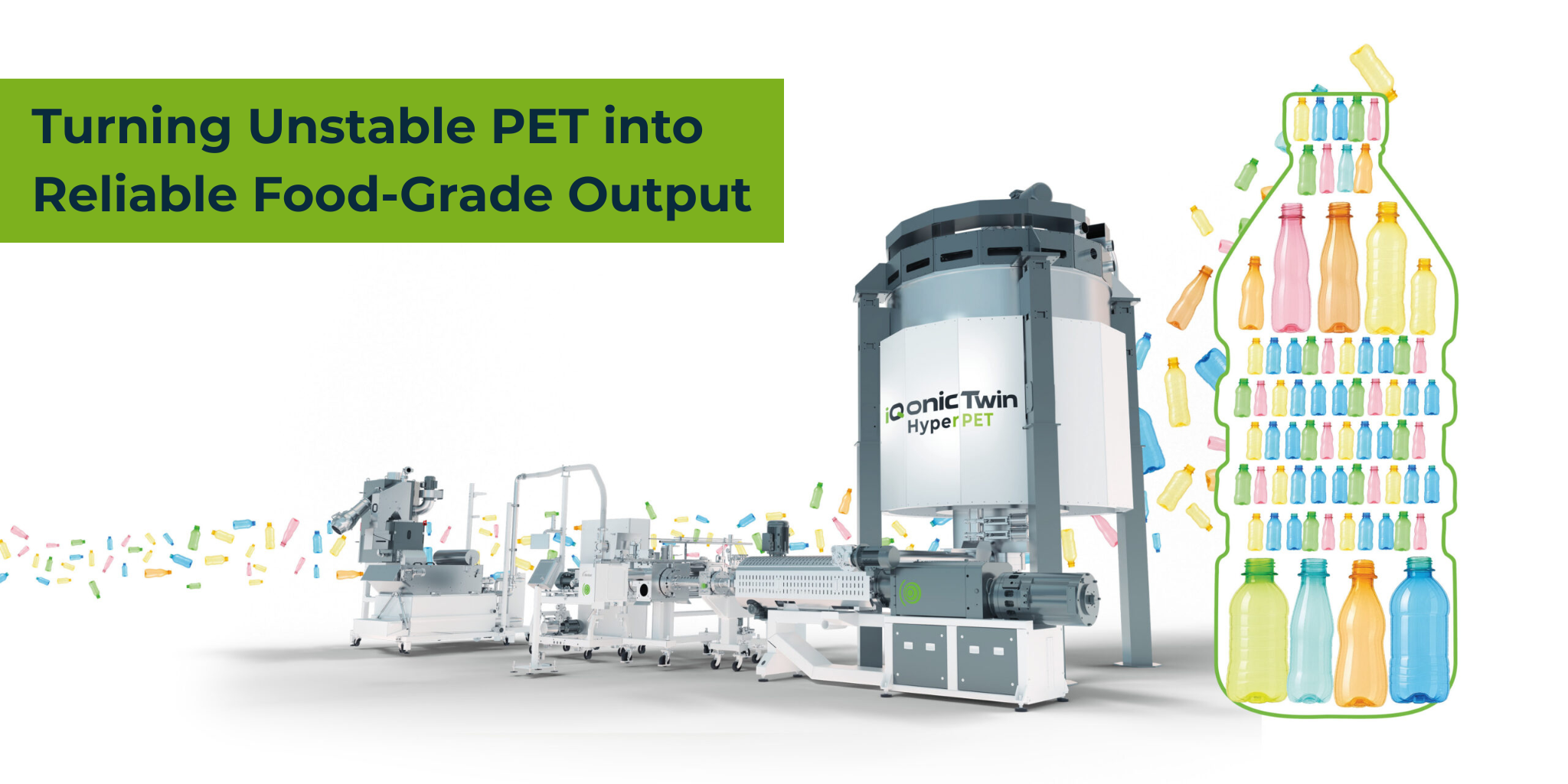
MAS addresses this challenge with a recycling-specific extrusion approach. The conical co-rotating twin-screw extruder is designed for gentle processing with low shear and short residence time. This minimizes polymer degradation and ensures stable IV and low AA levels.
The HyperPET solution combines this extrusion technology with SSP, enabling consistent food-grade output even with variable input materials.
This allows recyclers to expand their feedstock flexibility while maintaining stable quality – a key advantage in today’s market.
In a system under pressure, stability becomes the true competitive edge.