Table of contents
- Introduction and overview
- Area of application
- Legal basis
- Contact details of the person responsible
- Storage duration
- Rights under the General Data Protection Regulation
- Data transfer to third countries
- Security of data processing
- Communication
- Cookies
- Webhosting introduction
- Website modular systems Introduction
- Web Analytics Introduction
- Cookie Consent Management Platform Introduction
- Security & Anti-Spam
- Audio & Video Introduction
- Online map services Introduction
- Other Introduction
- Explanation of terms used
Introduction and overview
We have drawn up this privacy policy (version 28.11.2023–112009279) in order to inform you in accordance with the requirements of the Datenschutz-Grundverordnung (EU) 2016/679 and applicable national laws, which personal data (data for short) we as the controller — and the processors commissioned by us (e.g. providers) — process, will process in the future and what lawful options you have. The terms used are to be understood as gender-neutral
In short: We provide you with comprehensive information about the data we process about you.
Data protection declarations usually sound very technical and use legal terminology. This privacy policy, on the other hand, is intended to describe the most important things to you as simply and transparently as possible. Technical terms are explained in a reader-friendly way, links to further information are provided and graphics are used where this is conducive to transparency. We thus inform you in clear and simple language that we only process personal data as part of our business activities if there is a corresponding legal basis. This is certainly not possible if you make the most concise, unclear and legal-technical statements possible, as is often standard on the Internet when it comes to data protection. I hope you find the following explanations interesting and informative and perhaps there is one or two pieces of information that you did not yet know.
If you still have any questions, please contact the responsible body named below or in the imprint, follow the links provided and view further information on third-party websites. Our contact details can of course also be found in the imprint
Area of application
This privacy policy applies to all personal data processed by us in the company and to all personal data processed by companies commissioned by us (processors). By personal data, we mean information within the meaning of Art. 4 No. 1 GDPR, such as a person’s name, email address and postal address. The processing of personal data ensures that we can offer and bill our services and products, whether online or offline. The scope of this privacy policy includes
- all online presences (websites, online stores) that we operate
- Social media presences and e‑mail communicationmobile apps
- for smartphones and other devices
In short, the privacy policy applies to all areas in which personal data is processed in the company in a structured manner via the channels mentioned. If we enter into a legal relationship with you outside of these channels, we will inform you separately if necessary.
Legal basis
In the following privacy policy, we provide you with transparent information on the legal principles and regulations, i.e. the legal basis of the General Data Protection Regulation, which enable us to process personal data. As far as EU law is concerned, we refer to REGULATION (EU) 2016/679 OF THE EUROPEAN PARLIAMENT AND OF THE COUNCIL of 27 April 2016. You can of course access this EU General Data Protection Regulation online on EUR-Lex, the gateway to EU law, at https://eur-lex.europa.eu/legal-content/DE/ALL/?uri=celex%3A32016R0679 read more.
We only process your data if at least one of the following conditions applies:
- Consent (Article 6(1)(a) GDPR): You have given us your consent to process data for a specific purpose. An example would be the storage of the data you entered in a contact form.
- Contract (Article 6(1)(b) GDPR): In order to fulfil a contract or pre-contractual obligations with you, we process your data. For example, if we conclude a purchase contract with you, we need personal information in advance..
- Legal obligation (Article 6(1)© GDPR): If we are subject to a legal obligation, we process your data. For example, we are legally obliged to keep invoices for accounting purposes. These usually contain personal data
- Legitimate interests (Article 6(1)(f) GDPR): In the case of legitimate interests that do not restrict your fundamental rights, we reserve the right to process personal data. For example, we need to process certain data in order to operate our website securely and efficiently. This processing is therefore a legitimate interest.
Other conditions such as the fulfilment of recording in the public interest and the exercise of official authority as well as the protection of vital interests do not generally arise for us. If such a legal basis is relevant, it will be indicated at the appropriate point.
In addition to the EU regulation, national laws also apply:
- In Austria, this is the Federal Act on the Protection of Natural Persons with regard to the Processing of Personal Data (Data Protection Act), or DSG for short.
- In Germany, the Federal Data Protection Act (BDSG) applies.
If other regional or national laws apply, we will inform you of this in the following sections.
Contact details of the person responsible
If you have any questions about data protection or the processing of personal data, you will find the contact details of the person or body responsible below: M‑A-S Maschinen- und Anlagenbau Schulz GmbH Hobelweg 1 A‑4055 Pucking
E‑Mail: office@mas-austria.com
Telefon: +43 (0) 7229 / 789 99 0
Impressum: https://mas-tech.com/datenschutz
Storage duration
It is a general criterion for us that we only store personal data for as long as is absolutely necessary for the provision of our services and products. This means that we delete personal data as soon as the reason for the data processing no longer exists. In some cases, we are legally obliged to store certain data even after the original purpose has ceased to exist, for example for accounting purposes.Rights under the General Data Protection Regulation
In accordance with Articles 13 and 14 GDPR, we inform you of the following rights to which you are entitled in order to ensure fair and transparent processing of data:
- According to Article 15 GDPR, you have a right to information about whether we process your data. If this is the case, you have the right to receive a copy of the data and the following information:
- the purpose for which we carry out the processing;
- the categories, i.e. the types of data that are processed;
- who receives this data and, if the data is transferred to third countries, how security can be guaranteed;
- how long the data will be stored;
- the existence of the right to rectification, erasure or restriction of processing and the right to object to processing;
- that you can lodge a complaint with a supervisory authority (links to these authorities can be found below);
- the origin of the data if we have not collected it from you;
- whether profiling is carried out, i.e. whether data is automatically analysed in order to create a personal profile of you.
- According to Article 16 GDPR, you have a right to rectification of data, which means that we must correct data if you find errors.
- According to Article 17 GDPR, you have the right to erasure (“right to be forgotten”), which specifically means that you may request the erasure of your data..
- According to Article 18 GDPR, you have the right to restriction of processing, which means that we may only store the data but not use it any further.
- According to Article 20 GDPR, you have the right to data portability, which means that we will provide you with your data in a commonly used format upon request.
- According to Article 21 GDPR, you have the right to object, which will result in a change in the processing after enforcement.
- If the processing of your data is based on Article 6(1)(e) (public interest, exercise of official authority) or Article 6(1)(f) (legitimate interest), you can object to the processing. We will then check as quickly as possible whether we can legally honour this objection.
- If data is used for direct marketing purposes, you can object to this type of data processing at any time. We may then no longer use your data for direct marketing.
- If data is used for profiling purposes, you can object to this type of data processing at any time. We may then no longer use your data for profiling.
- Under Article 22 GDPR, you may have the right not to be subject to a decision based solely on automated processing (e.g. profiling).
- According to Article 77 GDPR, you have the right to lodge a complaint. This means that you can lodge a complaint with the data protection authority at any time if you believe that the processing of your personal data is in breach of the GDPR.
In short: You have rights — do not hesitate to contact the responsible office listed above!
If you believe that the processing of your data violates data protection law or that your data protection rights have been violated in any other way, you can lodge a complaint with the supervisory authority. For Austria, this is the data protection authority, whose website you can find at https://www.dsb.gv.at/ find. In Germany, there is a data protection officer for each federal state. For more information, you can contact the Bundesbeauftragte für den Datenschutz und die Informationsfreiheit (BfDI) find. In Germany, there is a data protection officer for each federal state. For more information, you can contact the
Austria Data Protection Authority
Leiterin: Mag. Dr. Andrea Jelinek
Adresse: Barichgasse 40–42, 1030 Wien
Telefonnr.: +43 1 52 152–0
E‑Mail-Adresse: dsb@dsb.gv.at
Website: https://www.dsb.gv.at/
Data transfer to third countries
Data processing by US services that are not active participants in the EU-US Data Privacy Framework may result in data not being processed and stored in anonymised form. Furthermore, US government authorities may be able to access individual data. In addition, data collected may be linked to data from other services of the same provider if you have a corresponding user account. Where possible, we endeavour to use server locations within the EU if this is offered. We will inform you in more detail about data transfer to third countries, if applicable, in the appropriate sections of this privacy policy.
Security of data processing
TLS encryption with https
TLS, encryption and https sound very technical — and they are. We use HTTPS (the Hypertext Transfer Protocol Secure stands for “secure hypertext transfer protocol”) to transmit data tap-proof on the Internet.
This means that the complete transmission of all data from your browser to our web server is secured — nobody can “eavesdrop” (Artikel 25 Absatz 1 DSGVO). By using TLS (Transport Layer Security), an encryption protocol for secure data transmission on the Internet, we can ensure the protection of confidential data.
You can recognise the use of this data transmission protection by the small lock symbol  at the top left of the browser, to the left of the Internet address (e.g. examplepage.com) and the use of the https scheme (instead of http) as part of our Internet address. If you would like to know more about encryption, we recommend a Google search for “Hypertext Transfer Protocol Secure wiki” to get good links to further information.
Communication
Communication Summary 👥 Data subjects: All those who communicate with us by phone, email, or online form |
When you contact us and communicate by telephone, e‑mail or online form, personal data may be processed. The data is processed for the handling and processing of your enquiry and the associated business transaction. The data will be stored for as long as required by law.Betroffene Personen
The above-mentioned processes affect everyone who contacts us via the communication channels we provide.
Phone
When you call us, the call data is stored pseudonymised on the respective end device and with the telecommunications provider used. In addition, data such as your name and telephone number may subsequently be sent by e‑mail and stored for the purpose of responding to your enquiry. The data is deleted as soon as the business transaction has been completed and legal requirements permit.
E‑Mail
If you communicate with us by email, data may be stored on the respective end device (computer, laptop, smartphone, etc.) and data may be stored on the email server. The data is deleted as soon as the business transaction has been completed and legal requirements permit.
Online forms
If you communicate with us using an online form, data is stored on our web server and may be forwarded to one of our e‑mail addresses. The data will be deleted as soon as the business transaction has been completed and legal requirements permit.
Legal basis
The processing of the data is based on the following legal bases:
- Art. 6 para. 1 lit. a GDPR (consent): You give us your consent to store your data and to use it for purposes relating to the business transaction;
- Art. 6 para. 1 lit. b GDPR (contract): It is necessary for the fulfilment of a contract with you or a processor, such as the telephone provider, or we need to process the data for pre-contractual activities, such as the preparation of an offer;
- Art. 6 para. 1 lit. f GDPR (legitimate interests): We want to handle customer enquiries and business communication in a professional manner. This requires certain technical facilities such as email programmes, exchange servers and mobile network operators in order to operate communication efficiently.
Cookies
| Cookies summary Cookies summary👥 Affected parties: Website visitors 🤝 Purpose: Depends on the respective cookie. You can find more details below or from the manufacturer of the software that sets the cookie. 📓 Data processed: Depends on the respective cookie used. You can find more details below or from the manufacturer of the software that sets the cookie. 📅 Storage period: Depends on the respective cookie; can vary from hours to years ⚖️ Legal basis: Art. 6 (1) (a) GDPR (consent), Art. 6 (1) (f) GDPR (legitimate interests) |
What are cookies?
Our website uses HTTP cookies to store user-specific data.
Below, we explain what cookies are and why they are used so that you can better understand the following privacy policy.
Whenever you surf the internet, you use a browser. Common browsers include Chrome, Safari, Firefox, Internet Explorer, and Microsoft Edge. Most websites store small text files in your browser. These files are called cookies.
One thing is undeniable: cookies are truly useful little helpers. Almost all websites use cookies. To be more precise, they are HTTP cookies, as there are other cookies for other purposes. HTTP cookies are small files that our website stores on your computer. These cookie files are automatically stored in the cookie folder, the “brain” of your browser. A cookie consists of a name and a value. When defining a cookie, one or more attributes must also be specified.
Cookies store certain user data from you, such as language or personal page settings. When you visit our site again, your browser sends the “user-related” information back to our site. Thanks to cookies, our website knows who you are and offers you the settings you are used to. In some browsers, each cookie has its own file; in others, such as Firefox, all cookies are stored in a single file.
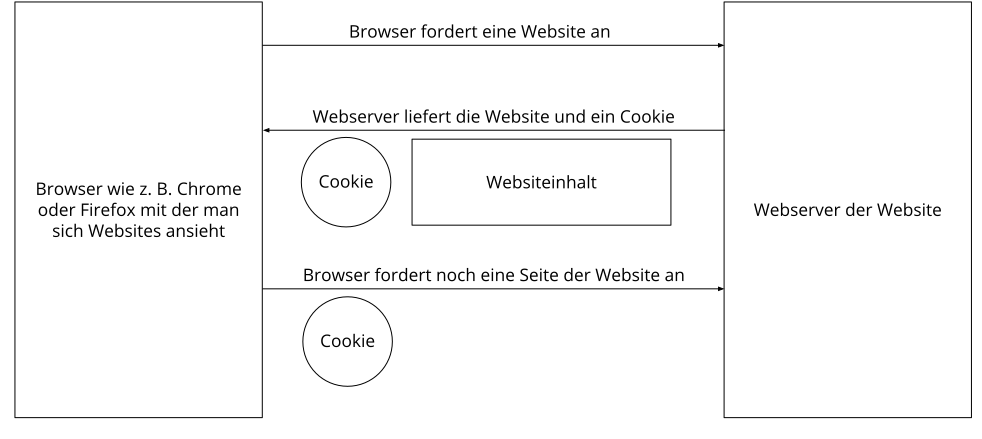
The following graphic shows a possible interaction between a web browser, such as Chrome, and the web server. The web browser requests a website and receives a cookie back from the server, which the browser uses again whenever another page is requested.
There are both first-party and third-party cookies. First-party cookies are created directly by our site, while third-party cookies are created by partner websites (e.g., Google Analytics). Each cookie must be evaluated individually, as each cookie stores different data. The expiration time of a cookie also varies from a few minutes to a few years. Cookies are not software programs and do not contain viruses, Trojans, or other “malware.” Cookies also cannot access information on your PC.
For example, cookie data might look like this:
Name: _ga
Value: GA1.2.1326744211.152112009279–9
Purpose of use: Differentiation of website visitors
Expiration date: after 2 years
A browser should be able to support these minimum sizes:
- At least 4096 bytes per cookie
- At least 50 cookies per domain
- At least 3000 cookies in total
What types of cookies are there?
The specific cookies we use depend on the services used and are explained in the following sections of this privacy policy. At this point, we would like to briefly discuss the different types of HTTP cookies.
There are four types of cookies:
Essential cookies These cookies are necessary to ensure basic website functions. For example, these cookies are needed when a user adds a product to their shopping cart, then continues browsing to other pages and only proceeds to checkout later. These cookies ensure that the shopping cart is not deleted even when the user closes their browser window.
Purposeful cookies These cookies collect information about user behavior and whether the user receives any error messages. These cookies also measure the loading time and behavior of the website in different browsers.
Targeted cookies These cookies improve user experience. For example, entered locations, font sizes, or form data are saved.
Werbe-Cookies
These cookies improve user experience. For example, entered locations, font sizes, or form data are saved.
Typically, when you first visit a website, you will be asked which of these cookie types you wish to accept. And, of course, this decision will also be saved in a cookie.
If you would like to know more about cookies and are not afraid of technical documentation, we recommend https://datatracker.ietf.org/doc/html/rfc6265, the Request for Comments from the Internet Engineering Task Force (IETF) called “HTTP State Management Mechanism”.
Purpose of processing via cookies
The purpose ultimately depends on the specific cookie. You can find more details below or contact the manufacturer of the software that sets the cookie.
What data is processed?
Cookies are small helpers for a variety of tasks. Unfortunately, it’s not possible to generalize what data is stored in cookies, but we will inform you about the data processed and stored in the following privacy policy.
Storage period of cookies
The storage period depends on the respective cookie and is further specified below. Some cookies are deleted after less than one hour, others can remain stored on a computer for several years.
You also have control over the storage period. You can manually delete all cookies via your browser at any time (see also “Right of objection” below). Furthermore, cookies based on consent will be deleted at the latest after your consent has been revoked, although the legality of their storage remains unaffected until then.
Right of objection – how can I delete cookies?
You decide how and whether you want to use cookies. Regardless of the service or website from which the cookies originate, you always have the option to delete, disable, or only partially accept cookies. For example, you can block third-party cookies but allow all other cookies.
If you want to find out which cookies have been stored in your browser, or if you want to change or delete cookie settings, you can do so in your browser settings:
Chrome: Cookies in Chrome löschen, aktivieren und verwalten
Safari: Verwalten von Cookies und Websitedaten mit Safari
Internet Explorer: Löschen und Verwalten von Cookies
Microsoft Edge: Löschen und Verwalten von Cookies
If you don’t want cookies at all, you can set your browser to always notify you when a cookie is about to be set. This allows you to decide for each individual cookie whether or not to accept it. The process varies depending on your browser. The best way to find instructions is to search for “delete cookies in Chrome” or “disable cookies in Chrome” in the case of a Chrome browser.
Legal basis
The so-called “Cookie Guidelines” have been in existence since 2009. They state that the storage of cookies is a Einwilligung (Article 6 (1) (a) GDPR). However, reactions to these guidelines vary considerably across EU countries. In Austria, however, this directive was implemented in Section 96 (3) of the Telecommunications Act (TKG). In Germany, the cookie guidelines were not implemented as national law. Instead, this directive was largely implemented in Section 15 (3) of the Telemedia Act (TMG).
For strictly necessary cookies, even if no consent has been given,berechtigte Interessen
(Article 6 (1) (f) GDPR), which in most cases are of an economic nature. We want to provide website visitors with a pleasant user experience, and for this, certain cookies are often absolutely necessary.
If non-essential cookies are used, this only happens with your consent. The legal basis in this regard is Article 6 (1) (a) GDPR.
In the following sections, you will be informed in more detail about the use of cookies, provided that the software used uses cookies.
Web hosting introduction
| Web Hosting Summary 👥 Data subjects: Website visitors 🤝 Purpose: Professional website hosting and operational security 📓 Data processed: IP address, time of website visit, browser used, and other data. You can find more details below or from the web hosting provider used. 📅 Storage period: Depends on the respective provider, but usually 2 weeks ⚖️ Legal basis: Art. 6 (1) (f) GDPR (Legitimate interests) |
What is web hosting?
When you visit websites these days, certain information – including personal data – is automatically created and stored, including on this website. This data should be processed as sparingly as possible and only with justification. By “website,” we mean the entirety of all web pages on a domain, i.e., everything from the home page to the very last subpage (like this one). By “domain,” we mean, for example, example.de or sampleexample.com.
If you want to view a website on a computer, tablet, or smartphone, you use a program called a web browser. You probably know some web browsers by name: Google Chrome, Microsoft Edge, Mozilla Firefox, and Apple Safari. We simply refer to them as “browser” or “web browser.”
To display the website, the browser must connect to another computer where the website’s code is stored: the web server. Operating a web server is a complex and time-consuming task, which is why it is usually handled by professional providers. These offer web hosting and thus ensure reliable and error-free storage of website data. A lot of technical terms, but please stay tuned, it gets better!
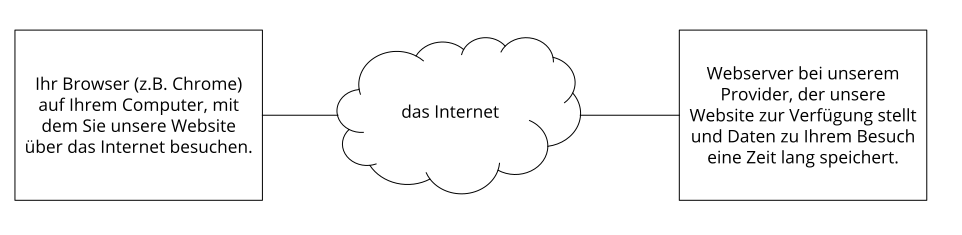
When the browser connects to your computer (desktop, laptop, tablet, or smartphone) and during data transfer to and from the web server, personal data may be processed. On the one hand, your computer stores data, and on the other hand, the web server must also store data for a while to ensure proper operation.
A picture is worth a thousand words, so the following graphic illustrates the interaction between the browser, the internet, and the hosting provider.
Why do we process personal data?
The purposes of data processing are:
- Professional website hosting and operational security
- to maintain operational and IT security
- Anonymous evaluation of access behavior to improve our service and, if necessary, for criminal prosecution or the pursuit of claims
What data is processed?
Even while you are currently visiting our website, our web server, which is the computer on which this website is stored, usually automatically saves data such as
- the complete Internet address (URL) of the accessed website
- Browser and browser version (e.g., Chrome 87)
- The operating system used (e.g., Windows 10)
- The address (URL) of the previously visited page (referrer URL) (e.g.). https://www.beispielquellsite.de/vondabinichgekommen/)
- The hostname and IP address of the device from which access is made (e.g., COMPUTERNAME and 194.23.43.121)
- Data and time
- in files, the so-called web server log files
How long is data stored?
As a rule, the above-mentioned data is stored for two weeks and then automatically deleted. We do not share this data, but cannot rule out the possibility that it may be viewed by authorities in the event of illegal behavior.
In short: Your visit is logged by our provider (the company that runs our website on special computers (servers)), but we do not share your data without your consent!
Legal Basis
The legality of the processing of personal data within the framework of web hosting arises from Art. 6 (1) (f) GDPR (protection of legitimate interests), as the use of professional hosting with a provider is necessary to present the company securely and user-friendly on the Internet and to be able to pursue attacks and claims arising from this if necessary.
There is usually a contract for data processing between us and the hosting provider in accordance with Art. 28 f) GDPR, which ensures compliance with data protection and guarantees data security.
Raidboxes Privacy Policy
We use the web hosting provider Raidboxes for our website. The service provider is the German company Raidboxes GmbH, Hafenstraße 32, 48153 Münster, Germany.
You can learn more about the data processed through the use of Raidboxes in the Privacy Policy on https://raidboxes.io/legal/privacy/.
Website modular systems Introduction
| Website Modular Systems Privacy Policy Summary 👥 Data subjects: Website visitors 🤝 Purpose: Optimizing our service 📓 Data processed: Data such as technical usage information such as browser activity, clickstream activity, session heatmaps, contact details, IP address, or your geographical location. You can find more details further down in this privacy policy and in the privacy policy of the providers. 📅 Storage period: depends on the provider ⚖️ Legal basis: Art. 6 (1) (f) GDPR (legitimate interests), Art. 6 (1) (a) GDPR (consent) |
What are website builders?
We use a website builder system for our website. Builder systems are special forms of content management systems (CMS). With a builder system, website operators can create a website very easily and without any programming knowledge. Many web hosts also offer builder systems. Using a builder system may also collect, store, and process your personal data. This privacy policy provides you with general information about data processing by builder systems. Further information can be found in the provider’s privacy policy.
Why do we use website builders for our website?
The biggest advantage of a modular system is its ease of use. We want to offer you a clear, simple, and well-organized website that we can easily operate and maintain ourselves—without external support. A modular system now offers many helpful features that we can use even without programming knowledge. This allows us to design our web presence according to our wishes and offer you an informative and enjoyable experience on our website.
What data is stored by a modular system?
Exactly which data is stored depends, of course, on the website builder system used. Each provider processes and collects different types of website visitor data. However, technical usage information such as operating system, browser, screen resolution, language and keyboard settings, hosting provider, and the date of your website visit are generally collected. Tracking data (e.g., browser activity, clickstream activity, session heatmaps, etc.) may also be processed. Personal data may also be collected and stored. This usually includes contact information such as email address, telephone number (if you have provided it), IP address, and geographic location data. You can find out exactly which data is stored in the provider’s privacy policy.
How long and where is the data stored?
We will inform you about the duration of data processing below in connection with the website modular system used, if we have further information about it. You can find detailed information about this in the provider’s privacy policy. In general, we only process personal data for as long as it is absolutely necessary to provide our services and products. The provider may store your data according to its own specifications, over which we have no influence.
Right of objection
You always have the right to access, correct, and delete your personal data. If you have any questions, you can also contact the person responsible for the website building block system you use at any time. Contact details can be found either in our privacy policy or on the website of the respective provider.
You can delete, deactivate, or manage cookies that providers use for their functions in your browser. Depending on the browser you use, this works differently. Please note, however, that not all functions may then work as usual.
Legal basis
We have a legitimate interest in using a website builder system to optimize our online service and present it to you in an efficient and user-friendly manner. The legal basis for this is Art. 6 (1) (f) GDPR (legitimate interests). However, we only use the builder system if you have given your consent.
If the processing of data is not absolutely necessary for the operation of the website, the data will only be processed based on your consent. This particularly applies to tracking activities. The legal basis in this regard is Art. 6 (1) (a) GDPR.
With this privacy policy, we have provided you with the most important general information about data processing. If you would like more detailed information on this, you can find further information – if available – in the following section or in the provider’s privacy policy.
WordPress.com Privacy Policy
| WordPress.com Privacy Policy Summary 👥 Affected parties: Website visitors 🤝 Purpose: Optimizing our service 📓 Data processed: Data such as technical usage information such as browser activity, clickstream activity, session heatmaps, contact details, IP address, or your geographical location. You can find more details further down in this privacy policy. 📅 Storage period: This depends primarily on the type of data stored and the specific settings. ⚖️ Legal basis: Art. 6 (1) (a) GDPR (consent), Art. 6 (1) (f) GDPR (legitimate interests)) |
What is WordPress?
We use the well-known content management system WordPress.com for our website. The service provider is the American company Automattic Inc., 60 29th Street #343, San Francisco, CA 94110, USA.
The company was founded in 2003 and, in a relatively short time, developed into one of the most well-known content management systems (CMS) in the world. A CMS is software that helps us design our website and present content in a beautiful and organized manner. The content can be text, audio, and video.
By using WordPress, personal data may also be collected, stored, and processed. Typically, technical data such as operating system, browser, screen resolution, or hosting provider is stored. However, personal data such as IP address, geographical data, or contact details may also be processed.
Why do we use WordPress on our website?
We have many strengths, but real programming is simply not one of our core competencies.
Nevertheless, we want to have a powerful and attractive website that we can manage and maintain ourselves. With a website builder or content management system like WordPress, this is exactly what we can achieve. With WordPress, we don’t have to be programming aces to offer you a beautiful website. Thanks to WordPress, we can operate our website quickly and easily, even without prior technical knowledge. If technical problems arise or we have special requests for our website, we always have our specialists who are at home in HTML, PHP, CSS, and the like.
Thanks to WordPress’s ease of use and comprehensive features, we can design our website according to our wishes and offer you a good user experience.
What data does WordPress process?
Non-personal data includes technical usage information such as browser activity, clickstream activity, session heatmaps, and data about your computer, operating system, browser, screen resolution, language and keyboard settings, internet service provider, and the date of the page visit.
Personal data is also collected. This primarily includes contact information (email address or phone number, if you provide it), IP address, or your geographic location.
WordPress may also use cookies to collect data. These often contain data about your behavior on our website. For example, it can record which subpages you particularly like to view, how long you stay on individual pages, when you leave a page (bounce rate), or even your preferences (e.g., language selection). Based on this data, WordPress can also better tailor its own marketing measures to your interests and user behavior. The next time you visit our website, our website will be displayed as you previously configured it.
WordPress may also use technologies such as pixel tags (web beacons) to, for example, clearly identify you as a user and possibly offer interest-based advertising.
How long and where is the data stored?
How long the data is stored depends on various factors. It primarily depends on the type of data stored and the specific settings of the website. Generally, WordPress deletes data when it is no longer needed for its own purposes. There are, of course, exceptions, particularly when legal obligations stipulate longer retention of the data. Web server logs, which contain your IP address and technical data, are deleted by WordPress or Automattic after 30 days. Automattic uses the data for this time to analyze traffic on its own websites (for example, all WordPress pages) and to resolve any potential problems. Deleted content on WordPress websites is also stored in the trash for 30 days to enable recovery; after that, it may remain in backups and caches until they are deleted. The data is stored on Automattic’s American servers.
How can I delete my data or prevent data storage?
You have the right and opportunity to access your personal data at any time and to object to the use and processing of it. You can also file a complaint with a government supervisory authority at any time.
You also have the option to individually manage, delete, or deactivate cookies in your browser. However, please be aware that deactivated or deleted cookies may have a negative impact on the functionality of our WordPress site. Managing cookies works slightly differently depending on the browser you use. Under the “Cookies” section, you will find links to the relevant instructions for the most popular browsers.
Legal basis
If you have consented to the use of WordPress, the legal basis for the corresponding data processing is this consent. According to Art. 6 (1) (a) GDPR (consent), this consent constitutes the legal basis for the processing of personal data, as may occur when WordPress collects it.
We also have a legitimate interest in using WordPress to optimize our online service and present it attractively for you. The corresponding legal basis for this is Art. 6 (1) (f) GDPR (legitimate interests). However, we only use WordPress if you have given your consent.
WordPress or Automattic processes your data, among other places, in the USA. Automattic is an active participant in the EU-US Data Privacy Framework, which regulates the correct and secure transfer of personal data of EU citizens to the USA. You can find more information on https://commission.europa.eu/document/fa09cbad-dd7d-4684-ae60-be03fcb0fddf_en.
Automattic also uses so-called standard contractual clauses (= Art. 46, Paragraphs 2 and 3 GDPR). Standard contractual clauses (SCCs) are templates provided by the EU Commission and are intended to ensure that your data complies with European data protection standards even if it is transferred to and stored in third countries (such as the USA). Through the EU-US Data Privacy Framework and the standard contractual clauses, Automattic undertakes to comply with European data protection standards when processing your relevant data, even if the data is stored, processed, and managed in the USA. These clauses are based on an implementing decision of the EU Commission. You can find the decision and the corresponding standard contractual clauses here, among other places:
https://eur-lex.europa.eu/eli/dec_impl/2021/914/oj?locale=de
More details about the privacy policy and which data is processed and how by WordPress can be found on https://automattic.com/privacy/.
Web Analytics Introduction
| Web Analytics Privacy Policy Summary 👥 Affected parties: Website visitors 🤝 Purpose: Evaluation of visitor information to optimize the website. 📓 Data processed: Access statistics, which include data such as access locations, device data, access duration and time, navigation behavior, click behavior, and IP addresses. Further details can be found in the respective web analytics tool used. 📅 Storage period: Depends on the web analytics tool used ⚖️ Legal basis: Art. 6 (1) (a) GDPR (consent), Art. 6 (1) (f) GDPR (legitimate interests) |
What is web analytics?
We use software on our website to evaluate the behavior of website visitors, known as web analytics or web analysis for short. This data is collected and stored, managed and processed by the respective analytics tool provider (also known as a tracking tool). This data is used to create analyses of user behavior on our website and make it available to us as the website operator. In addition, most tools offer various testing options. For example, we can test which offers or content are most popular with our visitors. To do this, we show you two different offers for a limited period of time. After the test (a so-called A/B test), we know which product or content our website visitors find more interesting. For such testing procedures, as for other analytics procedures, user profiles can be created and the data stored in cookies.
Why do we use web analytics?
We have a clear goal in mind with our website: to provide the best web offering on the market for our industry. To achieve this goal, we want to offer the best and most interesting offering on the market, while also ensuring that you feel completely at home on our website. With the help of web analysis tools, we can take a closer look at the behavior of our website visitors and then improve our web offering for you and us accordingly. For example, we can determine the average age of our visitors, where they come from, when our website is most visited, or which content or products are particularly popular. All of this information helps us optimize the website and thus adapt it as best as possible to your needs, interests, and wishes.
What data is processed?
Exactly which data is stored depends, of course, on the analysis tools used. However, as a rule, we store information such as the content you view on our website, the buttons or links you click, the time you access a page, the browser you use, the device (PC, tablet, smartphone, etc.) you use to visit the website, and the computer system you use. If you have agreed to the collection of location data, this may also be processed by the web analysis tool provider.
Your IP address is also stored. According to the General Data Protection Regulation (GDPR), IP addresses are personal data. However, your IP address is usually stored pseudonymously (i.e., in an unrecognizable and abbreviated form). For the purposes of testing, web analysis, and web optimization, no direct data, such as your name, age, address, or email address, is stored. All of this data, if collected, is stored pseudonymously. This means that you cannot be identified as an individual.
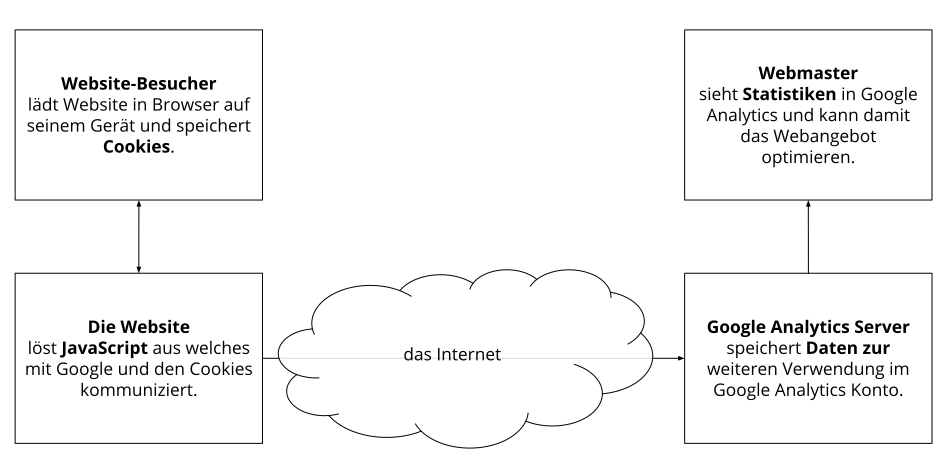
The following example shows schematically how Google Analytics works as an example of client-based web tracking with JavaScript code.
How long the respective data is stored always depends on the provider. Some cookies only store data for a few minutes or until you leave the website again; other cookies can store data for several years.
Duration of data processing
We will inform you below about the duration of data processing, as soon as we have further information. Generally, we only process personal data for as long as it is absolutely necessary to provide our services and products. If required by law, such as in the case of accounting, this retention period may be exceeded.
Right of objection
You also have the right and option to revoke your consent to the use of cookies or third-party services at any time. This can be done either via our cookie management tool or through other opt-out functions. For example, you can also prevent data collection through cookies by managing, deactivating, or deleting cookies in your browser.
Legal basis
The use of web analytics requires your consent, which we have obtained with our cookie popup. This consent is, according to Art. 6 Abs. 1 lit. a DSGVO (Einwilligung) The use of web analytics requires your consent, which we have obtained with our cookie popup. This consent is, according to
In addition to consent, we have a legitimate interest in analyzing the behavior of website visitors and thus improving our offering technically and economically. With the help of web analytics, we can detect website errors, identify attacks, and improve efficiency. The legal basis for this is Art. 6 Abs. 1 lit. f DSGVO (Berechtigte Interessen) . However, we only use the tools if you have given your consent.
Since web analytics tools use cookies, we also recommend reading our general privacy policy on cookies. To learn exactly which of your data is stored and processed, you should read the privacy policies of the respective tools.
Information on specific web analytics tools can be found – where available – in the following sections.
Google Analytics Privacy Policy
| Google Analytics Privacy Policy Summary 👥 Affected parties: Website visitors 🤝 Purpose: Evaluation of visitor information to optimize the website. 📓 Data processed: Access statistics, which include data such as access locations, device data, access duration and time, navigation behavior, and click behavior. You can find more details further down in this privacy policy. 📅 Storage period: Individually adjustable; by default, Google Analytics 4 stores data for 14 months. ⚖️ Legal basis: Art. 6 (1) (a) GDPR (consent), Art. 6 (1) (f) GDPR (legitimate interests) |
What is Google Analytics?
We use the analysis tracking tool Google Analytics, version Google Analytics 4 (GA4), from the American company Google Inc. on our website. Google Ireland Limited (Gordon House, Barrow Street, Dublin 4, Ireland) is responsible for all Google services in Europe. Google Analytics collects data about your actions on our website. Through the combination of various technologies such as cookies, device IDs, and login information, you as a user can be identified across different devices. This also allows your actions to be analyzed across platforms.
For example, if you click on a link, this event is stored in a cookie and sent to Google Analytics. The reports we receive from Google Analytics help us better tailor our website and our service to your needs. Below, we will discuss the tracking tool in more detail and, above all, inform you about which data is processed and how you can prevent this.
Google Analytics is a tracking tool used to analyze our website’s traffic. These measurements and analyses are based on a pseudonymous user identification number. This number does not contain any personal data such as name or address, but is used to assign events to a device. GA4 uses an event-based model that records detailed information on user interactions such as page views, clicks, scrolling, and conversion events. GA4 also incorporates various machine learning functions to better understand user behavior and certain trends. GA4 uses machine learning functions to model. This means that, based on the collected data, even missing data can be extrapolated in order to optimize the analysis and also to make forecasts.
For Google Analytics to work, a tracking code is embedded in the code of our website. When you visit our website, this code records various events that you perform on our website. With GA4’s event-based data model, we as website operators can define and track specific events to obtain analyses of user interactions. This allows us to track not only general information such as clicks or page views, but also specific events that are important to our business. Such special events can include, for example, submitting a contact form or purchasing a product.
As soon as you leave our website, this data is sent to the Google Analytics servers and stored there.
Google processes the data, and we receive reports on your user behavior. These reports may include, among others, the following:
Audience reports: Through audience reports, we get to know our users better and know more precisely who is interested in our service.
- Ad Reporting: Ad reporting helps us analyze and improve our online advertising.
- Acquisition Reports: Acquisition reports give us helpful information about how we can get more people excited about our service.
- Behavioral reports: This tells us how you interact with our website. We can track your path on our site and the links you click.
- Conversion reports: A conversion is a process in which you perform a desired action based on a marketing message. For example, when you go from being a mere website visitor to a buyer or newsletter subscriber. These reports help us learn more about how our marketing efforts are resonating with you. This is how we want to increase our conversion rate.
- Real-time reports: This lets us know immediately what’s happening on our website. For example, we can see how many users are currently reading this text.
In addition to the analysis reports mentioned above, Google Analytics 4 also offers the following features:
- Event-based data model: This model captures very specific events that can occur on our website. For example, playing a video, purchasing a product, or subscribing to our newsletter.
- Advanced analytics features: These features allow us to better understand your behavior on our website or certain general trends. For example, we can segment user groups, conduct comparative analyses of target groups, or track your journey or path through our website.
- Predictive modeling: Based on collected data, machine learning can extrapolate missing data to predict future events and trends. This can help us develop better marketing strategies.
- Cross-platform analysis: Data can be collected and analyzed from both websites and apps. This allows us to analyze user behavior across platforms, provided, of course, that you have consented to data processing.
Why do we use Google Analytics on our website?
Our goal with this website is clear: to offer you the best possible service. The statistics and data from Google Analytics help us achieve this goal.
The statistically analyzed data provides us with a clear picture of our website’s strengths and weaknesses. On the one hand, we can optimize our site so that it’s easier for interested people to find it on Google. On the other hand, the data helps us better understand you as a visitor. This allows us to know exactly what we need to improve on our website to offer you the best possible service. The data also helps us implement our advertising and marketing measures in a more personalized and cost-effective way. After all, it only makes sense to show our products and services to people who are interested in them.
What data does Google Analytics store?
Google Analytics uses a tracking code to create a random, unique ID linked to your browser cookie. This allows Google Analytics to recognize you as a new user and assign you a user ID. The next time you visit our site, you will be recognized as a “returning” user. All collected data is stored together with this user ID. This makes it possible to evaluate pseudonymous user profiles.
In order to analyze our website with Google Analytics, a property ID must be inserted into the tracking code. The data is then stored in the corresponding property. The Google Analytics 4 property is the default for every newly created property. Data is stored for different lengths of time depending on the property used.
Using identifiers such as cookies, app instance IDs, user IDs, or custom event parameters, your interactions are measured across platforms, provided you have consented. Interactions are all types of actions you perform on our website. If you also use other Google systems (such as a Google Account), data generated via Google Analytics may be linked to third-party cookies. Google does not share Google Analytics data unless we, as the website operator, approve it. Exceptions may apply if required by law.
According to Google, no IP addresses are logged or stored in Google Analytics 4. However, Google uses IP address data to derive location data and deletes it immediately afterwards. All IP addresses collected from users in the EU are deleted before the data is stored in a data center or on a server.
Because Google Analytics 4 focuses on event-based data, the tool uses significantly fewer cookies than previous versions (such as Google Universal Analytics). However, there are some specific cookies used by GA4. These include:
Name: _ga
Value: 2.1326744211.152112009279–5
Purpose: By default, analytics.js uses the _ga cookie to store the user ID. It is primarily used to distinguish between website visitors.
Expiry date: after 2 years
Name: _gid
Value: 2.1687193234.152112009279–1
Purpose: This cookie also serves to distinguish between website visitors.
Expiry date: after 24 hours
Name: _gat_gtag_UA_<property-id>
Value: 1
Purpose: Used to reduce the request rate. If Google Analytics is provided via Google Tag Manager, this cookie is named _dc_gtm_<property-id>.
Expiry date: after 1 minute
Note: This list cannot claim to be exhaustive, as Google continually changes its cookie choices. GA4 also aims to improve data protection. Therefore, the tool offers several options for controlling data collection. For example, we can specify the storage period ourselves and also control data collection.
Here we show you an overview of the most important types of data collected with Google Analytics:
Heatmaps: Google creates so-called heatmaps. Heatmaps show exactly the areas you click on. This gives us information about where you are on our site.
Session duration: Google defines the time you spend on our site without leaving the page as session duration. If you have been inactive for 20 minutes, the session ends automatically.
Bounce rate: A bounce occurs when you only view one page on our website and then leave our website again.
Account creation: When you create an account or place an order on our website, Google Analytics collects this data.
Location: IP addresses are not logged or stored in Google Analytics. However, location data is derived shortly before the IP address is deleted.
Technical information: Technical information includes, among other things, your browser type, your Internet service provider or your screen resolution.
Source: Google Analytics and we are of course also interested in which website or advertisement you came to our site from.
Other data includes contact information, any ratings, media playback (e.g., when you play a video on our site), sharing content via social media, or adding content to your favorites. This list is not exhaustive and serves only as a general guide to data storage by Google Analytics.
How long and where is the data stored?
Google has distributed its servers all over the world. Here you can find out exactly where Google’s data centers are located: https://datacenters.google/locations/
Your data is distributed across multiple physical storage devices. This has the advantage of being faster to access and better protected against tampering. Every Google data center has emergency backup programs for your data. If, for example, Google’s hardware fails or natural disasters cripple servers, the risk of service interruption at Google remains low.
The retention period for data depends on the properties used. The retention period is always determined individually for each property. Google Analytics offers us four options for controlling the retention period:
- 2 months: this is the shortest storage period.
- 14 months: By default, GA4 stores data for 14 months.
- 26 months: you can also store the data for 26 months.
- Data will only be deleted when we delete it manually
Additionally, you can choose to have data deleted only if you no longer visit our website within the period we select. In this case, the retention period will be reset each time you visit our website again within the specified period.
Once the specified period has expired, the data will be deleted once a month. This retention period applies to your data associated with cookies, user recognition, and advertising IDs (e.g., cookies from the DoubleClick domain). Report results are based on aggregated data and are stored independently of user data. Aggregated data is the merging of individual pieces of data into a larger unit.
How can I delete my data or prevent data storage?
Under European Union data protection law, you have the right to access, update, delete, or restrict your data. You can prevent Google Analytics 4 from using your data by using the Google Analytics JavaScript (analytics.js, gtag.js) browser add-on. You can download the browser add-on at https://tools.google.com/dlpage/gaoptout?hl=de
Download and install. Please note that this add-on only disables data collection by Google Analytics.
If you generally want to disable, delete, or manage cookies, you will find the relevant links to the instructions for the most popular browsers under the “Cookies” section.
Legal basis
The use of Google Analytics requires your consent, which we have obtained with our cookie popup. This consent is provided according to Art. 6 Abs. 1 lit. a DSGVO (Einwilligung) the legal basis for the processing of personal data, as may occur when collected by web analytics tools.
In addition to consent, we have a legitimate interest in analyzing the behavior of website visitors and thus improving our offering technically and economically. With the help of Google Analytics, we can detect errors on the website, identify attacks, and improve efficiency. The legal basis for this is Art. 6 Abs. 1 lit. f DSGVO (Berechtigte Interessen) . However, we only use Google Analytics if you have given your consent.
Google processes your data, among other places, in the USA. Google is an active participant in the EU-US Data Privacy Framework, which regulates the correct and secure transfer of personal data from EU citizens to the USA. You can find more information on https://commission.europa.eu/document/fa09cbad-dd7d-4684-ae60-be03fcb0fddf_en.
In addition, Google uses so-called standard contractual clauses (= Art. 46 (2) and (3) GDPR). Standard contractual clauses (SCCs) are templates provided by the EU Commission and are intended to ensure that your data complies with European data protection standards even if it is transferred to and stored in third countries (such as the USA). Through the EU-US Data Privacy Framework and the standard contractual clauses, Google undertakes to comply with European data protection standards when processing your relevant data, even if the data is stored, processed, and managed in the USA. These clauses are based on an implementing decision of the EU Commission. You can find the decision and the corresponding standard contractual clauses here, among other places: https://eur-lex.europa.eu/eli/dec_impl/2021/914/oj?locale=de
The Google Ads Data Processing Terms, which refer to the standard contractual clauses, can be found at https://business.safety.google/intl/de/adsprocessorterms/.
We hope we’ve been able to provide you with the most important information about Google Analytics’ data processing. If you’d like to learn more about the tracking service, we recommend these two links: https://marketingplatform.google.com/about/analytics/terms/de/ and
https://support.google.com/analytics/answer/6004245?hl=de.
If you want to learn more about data processing, please use the Google Privacy Policy on https://policies.google.com/privacy?hl=de.
Google Tag Manager Privacy Policy
| Google Tag Manager Privacy Policy Summary 👥 Affected parties: Website visitors 🤝 Purpose: Organization of the individual tracking tools 📓 Data processed: Google Tag Manager does not store any data itself. The data is collected by the tags of the web analytics tools used. 📅 Storage period: Depends on the web analytics tool used ⚖️ Legal basis: Art. 6 (1) (a) GDPR (consent), Art. 6 (1) (f) GDPR (legitimate interests)) |
What is the Google Tag Manager?
For our website, we use Google Tag Manager from Google Inc. For the European region, Google Ireland Limited (Gordon House, Barrow Street Dublin 4, Ireland) is responsible for all Google services. This Tag Manager is one of many helpful marketing products from Google. Google Tag Manager allows us to centrally integrate and manage code sections from various tracking tools that we use on our website.
In this privacy policy, we would like to explain in more detail what Google Tag Manager does, why we use it and how data is processed.
Google Tag Manager is an organizational tool that allows us to integrate and manage website tags centrally and via a user interface. Tags are small sections of code that record (track) your activities on our website, for example. For this purpose, JavaScript code sections are inserted into the source code of our site. The tags often originate from internal Google products such as Google Ads or Google Analytics, but tags from other companies can also be integrated and managed via the Manager. Such tags perform different tasks. They can collect browser data, feed marketing tools with data, integrate buttons, set cookies and also track users across multiple websites.
Why do we use Google Tag Manager for our website?
As the saying goes: organization is half the battle! And of course this also applies to the maintenance of our website. In order to make our website as good as possible for you and all people who are interested in our products and services, we need various tracking tools such as Google Analytics. The data collected by these tools shows us what you are most interested in, where we can improve our services and which people we should show our offers to. And for this tracking to work, we have to integrate the corresponding JavaScript codes into our website. In principle, we could integrate each code section of the individual tracking tools separately into our source code. However, this takes a relatively long time and it is easy to lose track. That’s why we use the Google Tag Manager. We can easily integrate the necessary scripts and manage them from one place. Google Tag Manager also offers an easy-to-use user interface and no programming knowledge is required. This is how we manage to keep order in our tag jungle.
What data is stored by Google Tag Manager?
The Tag Manager itself is a domain that does not set any cookies or store any data. It acts as a mere “manager” of the implemented tags. The data is recorded by the individual tags of the various web analysis tools. The data is passed through the Google Tag Manager to the individual tracking tools and is not saved.
However, the situation is completely different with the integrated tags of the various web analysis tools, such as Google Analytics. Depending on the analysis tool, various data about your web behavior is usually collected, stored and processed with the help of cookies. Please read our data protection texts for the individual analysis and tracking tools that we use on our website.
In the account settings of the Tag Manager, we have allowed Google to receive anonymized data from us. However, this only concerns the use and utilization of our Tag Manager and not your data that is stored via the code sections. We allow Google and others to receive selected data in anonymized form. We therefore consent to the anonymous sharing of our website data. Despite extensive research, we were unable to find out exactly which summarized and anonymous data is forwarded. In any case, Google deletes all information that could identify our website. Google combines the data with hundreds of other anonymous website data and creates user trends as part of benchmarking measures. Benchmarking involves comparing our own results with those of our competitors. Processes can be optimized on the basis of the information collected.
How long and where is the data stored?
When Google stores data, this data is stored on Google’s own servers. The servers are located all over the world. Most of them are located in America. Under https://datacenters.google/locations/ you can find out exactly where the Google servers are located.
You can find out how long the individual tracking tools store your data in our individual data protection texts for the individual tools.
How can I delete my data or prevent data storage?
The Google Tag Manager itself does not set cookies, but manages tags from various tracking websites. In our data protection texts on the individual tracking tools, you will find detailed information on how you can delete or manage your data.
Please note that when using this tool, your data may also be stored and processed outside the EU. Most third countries (including the USA) are not considered secure under current European data protection law. Data may therefore not simply be transferred to insecure third countries, stored and processed there, unless there are suitable guarantees (such as EU standard contractual clauses) between us and the non-European service provider.
Legal basis
The use of Google Tag Manager requires your consent, which we have obtained with our cookie pop-up. According to Art. 6 para. 1 lit. a GDPR (consent), this consent constitutes the legal basis for the processing of personal data, as may occur when it is collected by web analytics tools.
In addition to consent, we have a legitimate interest in analyzing the behavior of website visitors in order to improve our offer technically and economically. We can improve our efficiency with the help of the Google Tag Manager. The legal basis for this is Art. 6 para. 1 lit. f GDPR (legitimate interests) . Nevertheless, we only use Google Tag Manager if you have given your consent.
Google also processes your data in the USA, among other places. Google is an active participant in the EU-US Data Protection Framework, which regulates the correct and secure transfer of personal data of EU citizens to the USA. For more information, see https://commission.europa.eu/document/fa09cbad-dd7d-4684-ae60-be03fcb0fddf_en.
Google also uses so-called standard contractual clauses (= Art. 46 (2) and (3) GDPR). Standard Contractual Clauses (SCCs) are templates provided by the EU Commission and are intended to ensure that your data complies with European data protection standards even if it is transferred to third countries (such as the USA) and stored there. Through the EU-US Data Privacy Framework and the standard contractual clauses, Google undertakes to comply with the European level of data protection when processing your relevant data, even if the data is stored, processed and managed in the USA. These clauses are based on an implementing decision of the EU Commission. You can find the decision and the corresponding standard contractual clauses here: https://eur-lex.europa.eu/eli/dec_impl/2021/914/oj?locale=de
The Google Ads Data Processing Terms, which refer to the standard contractual clauses, can be found at https://business.safety.google/intl/de/adsprocessorterms/.
If you want to learn more about Google Tag Manager, we recommend the FAQs at https://support.google.com/tagmanager/?hl=de#topic=3441530.
You can find out which data Google generally collects and what they use this data for at https://policies.google.com/privacy?hl=de read more.
Cookie-Zustimmungsmanagement-Plattform Einführung
| Cookie Consent Management Platform Summary 👥 Affected: Website visitors 🤝 Purpose: Obtaining and managing consent for certain cookies and thus the use of certain tools 📓 Processed data: Data for managing the cookie settings set, such as IP address, time of consent, type of consent, individual consents. You can find more details on this in the respective tool used. 📅 Storage duration: Depends on the tool used, you have to be prepared for periods of several years ⚖️ Legal basis: Art. 6 para. 1 lit. a GDPR (consent), Art. 6 para. 1 lit.f GDPR (legitimate interests) |
What is a Cookie Consent Management Platform?
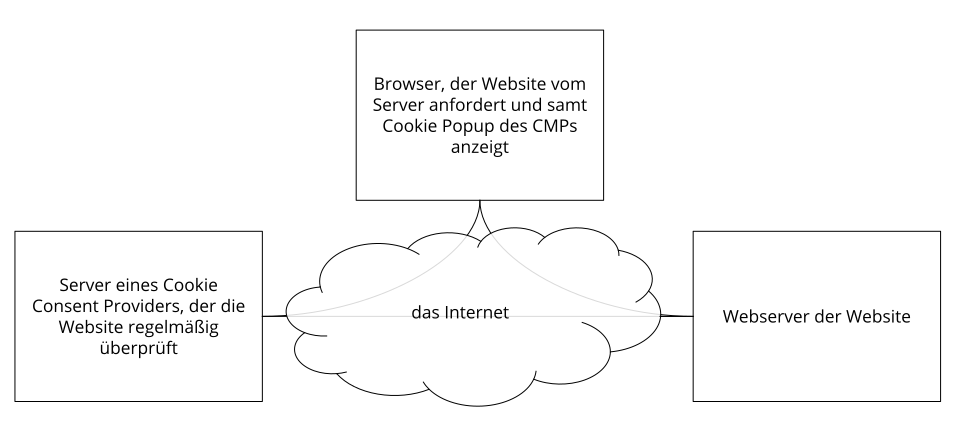
We use Consent Management Platform (CMP) software on our website, which makes it easier for us and you to handle scripts and cookies correctly and securely. The software automatically creates a cookie pop-up, scans and checks all scripts and cookies, provides you with the cookie consent required under data protection law and helps us and you to keep track of all cookies. Most cookie consent management tools identify and categorize all existing cookies. As a website visitor, you then decide for yourself whether and which scripts and cookies you allow or do not allow. The following graphic shows the relationship between browser, web server and CMP.
Why do we use a cookie management tool?
Our aim is to offer you the best possible transparency in the area of data protection. We are also legally obliged to do so. We want to provide you with as much information as possible about all tools and all cookies that can store and process your data. It is also your right to decide for yourself which cookies you accept and which you do not. In order to grant you this right, we first need to know exactly which cookies have landed on our website in the first place. Thanks to a cookie management tool that regularly scans the website for all existing cookies, we know about all cookies and can provide you with GDPR-compliant information about them. You can then accept or reject cookies via the consent system.
What data is processed?
As part of our cookie management tool, you can manage each individual cookie yourself and have complete control over the storage and processing of your data. The declaration of your consent is stored so that we do not have to ask you every time you visit our website and we can also prove your consent if required by law. This is stored either in an opt-in cookie or on a server. The storage period of your cookie consent varies depending on the provider of the cookie management tool. In most cases, this data (e.g. pseudonymous user ID, time of consent, details of cookie categories or tools, browser, device information) is stored for up to two years.
Duration of data processing
We will inform you about the duration of data processing below, if we have further information on this. In general, we only process personal data for as long as is absolutely necessary for the provision of our services and products. Data that is stored in cookies is stored for different lengths of time. Some cookies are deleted as soon as you leave the website, while others may be stored in your browser for several years. The exact duration of data processing depends on the tool used; in most cases, you should be prepared for a storage period of several years. You can usually find precise information about the duration of data processing in the respective data protection declarations of the individual providers.
Right of objection
You also have the right and the option to withdraw your consent to the use of cookies at any time. This works either via our cookie management tool or via other opt-out functions. For example, you can also prevent data collection by cookies by managing, deactivating or deleting cookies in your browser.
Information on special cookie management tools, if available, can be found in the following sections.
Legal basis
If you consent to cookies, your personal data will be processed and stored via these cookies. If we are permitted to use cookies on the basis of your consent (Article 6(1)(a) GDPR), this consent is also the legal basis for the use of cookies and the processing of your data. Cookie consent management platform software is used to manage your consent to cookies and to enable you to give your consent. The use of this software enables us to operate the website in an efficient and legally compliant manner, which constitutes a legitimate interest (Article 6(1)(f) GDPR).
AdSimple Consent Manager Privacy Policy
| AdSimple Consent Manager Privacy Policy Summary 👥 Affected: Website visitors 🤝 Purpose: Obtaining consent for certain cookies and thus the use of certain tools 📓 Processed data: Data for managing the cookie settings set, such as IP address, time of consent, type of consent, individual consents. You can find more details on this further below in this privacy policy 📅 Storage period: the cookie used expires after one year ⚖️ Legal basis: Art. 6 para. 1 lit. a GDPR (consent), Art. 6 para. 1 lit.f GDPR (legitimate interests) |
What is the AdSimple Consent Manager?
We use the AdSimple Consent Manager of the software development and online marketing company AdSimple GmbH, Fabriksgasse 20, 2230 Gänserndorf on our website. The AdSimple Consent Manager offers us, among other things, the opportunity to provide you with a comprehensive and data protection-compliant cookie notice so that you can decide for yourself which cookies you allow and which you do not. By using this software, data is sent from you to AdSimple and stored. In this privacy policy, we inform you why we use the AdSimple Consent Manager, what data is transferred and stored and how you can prevent this data transfer.
The AdSimple Consent Manager is a software that scans our website and identifies and categorizes all existing cookies. In addition, as a website visitor, you are informed about the use of cookies via a cookie notice script and decide for yourself which cookies you allow and which you do not.
Why do we use the AdSimple Consent Manager on our website?
We want to offer you maximum transparency in the area of data protection. To ensure this, we first need to know exactly which cookies have ended up on our website over time. Because AdSimple’s Consent Manager regularly scans our website and identifies all cookies, we have full control over these cookies and can therefore act in compliance with the GDPR. This enables us to inform you precisely about the use of cookies on our website. Furthermore, you will always receive an up-to-date and data protection-compliant cookie notice and can decide for yourself which cookies you accept or block using a checkbox system.
What data is stored by the AdSimple Consent Manager?
If you consent to cookies on our website, the following cookie will be set by the AdSimple Consent Manager:
Name: acm_status
Value: “:true, “statistics”:true, “marketing”:true, “socialmedia”:true, “settings”:true}
Purpose: Your consent status is stored in this cookie. This allows our website to read and follow the current status on future visits.
Expiration date: after one year
How long and where is the data stored?
All data collected by the AdSimple Consent Manager is transferred and stored exclusively within the European Union. The data collected is stored on AdSimple’s servers at Hetzner GmbH in Germany. Only AdSimple GmbH and Hetzner GmbH have access to this data.
How can I delete my data or prevent data storage?
You have the right to access and delete your personal data at any time. You can prevent data collection and storage, for example, by rejecting the use of cookies via the cookie hint script. Another option to prevent data processing or to manage it according to your wishes is offered by your browser. Depending on the browser, cookie management works slightly differently. In the “Cookies” section, you will find the relevant links to the instructions for the most popular browsers.
Legal basis
If you consent to cookies, your personal data will be processed and stored via these cookies. If we are permitted to use cookies on the basis of your consent (Article 6(1)(a) GDPR), this consent is also the legal basis for the use of cookies and the processing of your data. The AdSimple Consent Manager is used to manage consent to cookies and to enable you to give your consent. The use of this software enables us to operate the website in an efficient and legally compliant manner, which constitutes a legitimate interest (Article 6(1)(f) GDPR).
We hope we have provided you with a good overview of the data traffic and data processing by the AdSimple Consent Manager. If you would like to find out more about this tool, we recommend you visit the description page on https://www.adsimple.at/consent-manager/.
BorlabsCookie privacy policy
We use BorlabsCookie on our website, which is, among other things, a tool for storing your cookie consent. The service provider is the German company Borlabs — Benjamin A. Bornschein, Rübenkamp 32, 22305 Hamburg, Germany. You can find out more about the data processed through the use of BorlabsCookie in the privacy policy at https://de.borlabs.io/datenschutz/.
Security & Anti-Spam
| Security & Anti-Spam Privacy Policy Summary 👥 Affected parties: Visitors to the website 🤝 Purpose: Cybersecurity 📓 Processed data: Data such as your IP address, name or technical data such as browser version You can find more details on this below and in the individual data protection texts. 📅 Storage period: Most of the data is stored until it is no longer required for the fulfillment of the service ⚖️ Legal basis: Art. 6 para. 1 lit. a GDPR (consent), Art. 6 para. 1 lit. f GDPR (legitimate interests) |
What is security & anti-spam software?
With so-called security and anti-spam software, you and we can protect ourselves from various spam or phishing emails and possible other cyberattacks. Spam refers to advertising emails from a mass mailing that you did not request yourself. Such emails are also known as data junk and can also cause costs. Phishing emails, on the other hand, are messages that aim to build trust via fake messages or websites in order to obtain personal data. Anti-spam software generally protects against unwanted spam messages or malicious emails that could introduce viruses into our system. We also use general firewall and security systems to protect our computers from unwanted network attacks.
Why do we use security & anti-spam software?
We attach great importance to security on our website. After all, it’s not just about our security, but above all about yours. Unfortunately, cyber threats are now part of everyday life in the world of IT and the Internet. Hackers often try to steal personal data from an IT system with the help of a cyber attack. And that is why a good defense system is absolutely essential. A security system monitors all incoming and outgoing connections to our network or computer. To achieve even greater security against cyber attacks, we also use other external security services in addition to the standardized security systems on our computer. This prevents unauthorized data traffic and protects us from cybercrime.
What data is processed by security & anti-spam software?What data is processed by security & anti-spam software?
Exactly which data is collected and stored depends of course on the respective service. However, we always strive to use only programs that collect data very sparingly or only store data that is necessary for the performance of the service offered. In principle, the service may store data such as name, address, IP address, e‑mail address and technical data such as browser type or browser version. Any performance and log data may also be collected in order to detect possible incoming threats in good time. This data is processed as part of the services and in compliance with the applicable laws. This also includes the GDPR for US providers (via the standard contractual clauses). In some cases, these security services also work with third-party providers who may store and/or process data under instructions and in accordance with the data protection guidelines and other security measures. Data is usually stored via cookies.
Duration of data processing
We will inform you about the duration of data processing below if we have further information on this. For example, security programs store data until you or we revoke the data storage. In general, personal data is only stored for as long as is absolutely necessary for the provision of the services. Unfortunately, in many cases we do not receive precise information from the providers about the length of storage.
Right of objection
You also have the right and the option to withdraw your consent to the use of cookies or third-party security software at any time. This works either via our cookie management tool or via other opt-out functions. For example, you can also prevent data collection by cookies by managing, deactivating or deleting cookies in your browser.
As such security services may also use cookies, we recommend that you read our general privacy policy on cookies. To find out exactly which of your data is stored and processed, you should read the privacy policies of the respective tools.
Legal basis
We use the security services mainly on the basis of our legitimate interests (Art. 6 para. 1 lit. f GDPR) in a good security system against various cyber attacks.
Certain processing operations, in particular the use of cookies and the use of security functions, require your consent. If you have consented to your data being processed and stored by integrated security services, this consent is the legal basis for data processing (Art. 6 para. 1 lit. a GDPR). Most of the services we use set cookies in your browser to store data. We therefore recommend that you read our data protection text on cookies carefully and view the privacy policy or cookie guidelines of the respective service provider.
Information on special tools — if available — can be found in the following sections.
Google reCAPTCHA privacy policy
| Google reCAPTCHA privacy policy summary 👥 Affected parties: Visitors to the website 🤝 Purpose: Optimization of our service performance and protection against cyber attacks 📓 Processed data: Data such as IP address, browser information, your operating system, limited location and usage data More details can be found below in this privacy policy. 📅 Storage duration: depending on the stored data ⚖️ Legal basis: Art. 6 para. 1 lit. a GDPR (consent), Art. 6 para. 1 lit. f GDPR (legitimate interests) |
What is reCAPTCHA?
Our primary goal is to secure and protect our website for you and for us in the best possible way. To ensure this, we use Google reCAPTCHA from Google Inc. For the European region, the company Google Ireland Limited (Gordon House, Barrow Street Dublin 4, Ireland) is responsible for all Google services. With reCAPTCHA we can determine whether you are really a flesh and blood person and not a robot or other spam software. By spam we mean any unsolicited information that is sent to us electronically. With the classic CAPTCHAs, you usually had to solve text or picture puzzles for verification. With reCAPTCHA from Google, we don’t usually have to bother you with such puzzles. In most cases, all you have to do is tick a box to confirm that you are not a bot. With the new Invisible reCAPTCHA version, you no longer even have to tick the box. You can find out exactly how this works and, above all, which data is used for this in the course of this privacy policy.
reCAPTCHA is a free captcha service from Google that protects websites from spam software and misuse by non-human visitors. This service is most commonly used when you fill out forms on the Internet. A Captcha service is a type of automatic Turing test that is designed to ensure that an action on the Internet is performed by a human and not by a bot. In the classic Turing test (named after the computer scientist Alan Turing), a human determines the difference between a bot and a human. With captchas, this is also done by a computer or a software program. Classic captchas work with small tasks that are easy for humans to solve but present considerable difficulties for machines. With reCAPTCHA, you no longer have to actively solve puzzles. The tool uses modern risk techniques to distinguish humans from bots. All you have to do is check the “I am not a robot” text box or, with Invisible reCAPTCHA, even that is no longer necessary. With reCAPTCHA, a JavaScript element is integrated into the source code and then the tool runs in the background and analyzes your user behaviour. The software calculates a so-called captcha score from these user actions. Google uses this score to calculate the probability that you are human even before you enter the captcha. reCAPTCHA or captchas in general are always used when bots could manipulate or abuse certain actions (e.g. registrations, surveys, etc.).
Why do we use reCAPTCHA on our website?
We only want to welcome people of flesh and blood on our site. Bots and spam software of all kinds can safely stay at home. That’s why we do everything we can to protect ourselves and offer you the best possible user-friendliness. For this reason, we use Google reCAPTCHA from Google. This way we can be pretty sure that we remain a “bot-free” website. By using reCAPTCHA, data is transmitted to Google to determine whether you are actually a human being. reCAPTCHA therefore serves to ensure the security of our website and, by extension, your security. For example, without reCAPTCHA it could happen that a bot registers as many e‑mail addresses as possible during registration in order to subsequently “spam” forums or blogs with unwanted advertising content. With reCAPTCHA, we can prevent such bot attacks.
What data is stored by reCAPTCHA?
reCAPTCHA collects personal data from users in order to determine whether the actions on our website actually originate from people. The IP address and other data that Google requires for the reCAPTCHA service may therefore be sent to Google. IP addresses are almost always truncated within the member states of the EU or other signatory states to the Agreement on the European Economic Area before the data is sent to a server in the USA. The IP address is not combined with other Google data unless you are logged in with your Google account while using reCAPTCHA. First, the reCAPTCHA algorithm checks whether Google cookies from other Google services (YouTube, Gmail, etc.) have already been placed on your browser. Then reCAPTCHA sets an additional cookie in your browser and takes a snapshot of your browser window.
The following list of collected browser and user data is not intended to be exhaustive. Rather, they are examples of data that, to our knowledge, are processed by Google.
- Referrer URL (the address of the page from which the visitor comes)
IP address (e.g. 256.123.123.1) - Information about the operating system (the software that enables your computer to operate. Known operating systems are Windows, Mac OS X or Linux)
- Cookies (small text files that store data in your browser)
Mouse and keyboard behaviour (every action you perform with the mouse or keyboard is stored) - Date and language settings (which language or date you have preset on your PC is stored)
- All JavaScript objects (JavaScript is a programming language that enables websites to adapt to the user. JavaScript objects can collect all kinds of data under one name)
- Screen resolution (shows how many pixels the image display consists of)
It is undisputed that Google uses and analyzes this data even before you click on the “I am not a robot” checkbox. With the Invisible reCAPTCHA version, you don’t even have to check the box and the entire recognition process runs in the background. Google does not tell you in detail exactly how much and what data it stores.
The following cookies are used by reCAPTCHA: Here we refer to the reCAPTCHA demo version from Google at https://www.google.com/recaptcha/api2/demo. All these cookies require a unique identifier for tracking purposes. Here is a list of cookies that Google reCAPTCHA has set on the demo version:
Name: IDE
Value: WqTUmlnmv_qXyi_DGNPLESKnRNrpgXoy1K-pAZtAkMbHI-112009279–8
Purpose: This cookie is set by the company DoubleClick (also owned by Google) to register and report the actions of a user on the website when interacting with advertisements. This allows the effectiveness of advertising to be measured and appropriate optimization measures to be taken. IDE is stored in browsers under the domain doubleclick.net.
Expiration date: after one year
Name: 1P_JAR
Value: 2019–5‑14–12
Purpose: This cookie collects statistics on website usage and measures conversions. A conversion occurs, for example, when a user becomes a buyer. The cookie is also used to display relevant advertisements to users. The cookie can also be used to prevent a user from seeing the same ad more than once.
Expiration date: after one month
Name: ANID
Value: U7j1v3dZa1120092790xgZFmiqWppRWKOr
Purpose: We were unable to find out much information about this cookie. In Google’s privacy policy, the cookie is mentioned in connection with “advertising cookies” such as “DSID”, “FLC”, “AID”, “TAID”. ANID is stored under domain google.com.
Expiration date: after 9 months
Name: CONSENT
Value: YES+AT.de+20150628–20‑0
Purpose: The cookie stores the status of a user’s consent to the use of various Google services. CONSENT is also used for security purposes to verify users, prevent fraudulent login information and protect user data from unauthorized attacks.
Expiration date: after 19 years
Name: NID
Value: 0WmuWqy112009279zILzqV_nmt3sDXwPeM5Q
Purpose: NID is used by Google to customize ads to your Google searches. With the help of the cookie, Google “remembers” your most frequently entered search queries or your previous interaction with ads. So you always get customized ads. The cookie contains a unique ID to collect the user’s personal settings for advertising purposes.
Expiration date: after 6 months
Name: DV
Value: gEAABBCjJMXcI0dSAAAANbqc112009279‑4
Purpose: As soon as you have checked the “I am not a robot” box, this cookie is set. The cookie is used by Google Analytics for personalized advertising. DV collects information in anonymized form and is also used to make user distinctions.
Expiration date: after 10 minutes
Note: This list cannot claim to be exhaustive, as experience has shown that Google changes its choice of cookies from time to time.
How long and where is the data stored?
By inserting reCAPTCHA, data is transferred from you to the Google server. Where exactly this data is stored is not made clear by Google, even after repeated requests. Without having received confirmation from Google, it can be assumed that data such as mouse interaction, time spent on the website or language settings are stored on the European or American Google servers. The IP address that your browser transmits to Google is not merged with other Google data from other Google services. However, if you are logged into your Google account while using the reCAPTCHA plug-in, the data will be merged. The deviating data protection provisions of Google apply to this.
How can I delete my data or prevent data storage?
If you do not want any data about you and your behavior to be transmitted to Google, you must log out of Google completely and delete all Google cookies before you visit our website or use the reCAPTCHA software. In principle, the data is automatically transmitted to Google as soon as you visit our website. To delete this data again, you must contact Google support at https://support.google.com/?hl=de&tid=112009279 contact.
Therefore, when you use our website, you consent to Google LLC and its representatives automatically collecting, processing and using data.
Please note that when using this tool, your data may also be stored and processed outside the EU. Most third countries (including the USA) are not considered secure under current European data protection law. Data may therefore not simply be transferred to insecure third countries, stored and processed there, unless there are suitable guarantees (such as EU standard contractual clauses) between us and the non-European service provider.
Legal basis
If you have consented to the use of Google reCAPTCHA, the legal basis for the corresponding data processing is this consent. According to Art. 6 para. 1 lit. a GDPR (consent), this consent constitutes the legal basis for the processing of personal data, as may occur when Google reCAPTCHA is used.
We also have a legitimate interest in using Google reCAPTCHA to optimize our online service and make it more secure. The legal basis for this is Art. 6 para. 1 lit. f GDPR (legitimate interests). Nevertheless, we only use Google reCAPTCHA if you have given your consent.
Google also processes your data in the USA, among other places. Google is an active participant in the EU-US Data Privacy Framework, which regulates the correct and secure transfer of personal data from EU citizens to the USA. You can find more information on this at https://commission.europa.eu/document/fa09cbad-dd7d-4684-ae60-be03fcb0fddf_en.
Google also uses so-called standard contractual clauses (= Art. 46 (2) and (3) GDPR). Standard Contractual Clauses (SCCs) are templates provided by the EU Commission and are intended to ensure that your data complies with European data protection standards even if it is transferred to third countries (such as the USA) and stored there. Through the EU-US Data Privacy Framework and the standard contractual clauses, Google undertakes to comply with the European level of data protection when processing your relevant data, even if the data is stored, processed and managed in the USA. These clauses are based on an implementing decision of the EU Commission. You can find the decision and the corresponding standard contractual clauses here: https://eur-lex.europa.eu/eli/dec_impl/2021/914/oj?locale=de
The Google Ads Data Processing Terms, which refer to the standard contractual clauses, can be found at https://business.safety.google/intl/de/adsprocessorterms/.
You can find out more about reCAPTCHA on Google’s web developer page at https://developers.google.com/recaptcha/. Although Google goes into more detail about the technical development of reCAPTCHA here, you will search in vain for precise information about data storage and data protection issues. A good overview of the basic use of data at Google can be found in the company’s own privacy policy at https://policies.google.com/privacy.
iThemes Security Privacy Policy
We use iThemes Security for our website, a security plugin for the WordPress content management system. The service provider is the American company iThemes Media LLC, 1720 S Kelly Ave, Edmond, OK 73013, USA. In 2018, the company was acquired by Liquid Web LLC (2703 Ena Drive, Lansing, MI 48917, USA).
iThemes also processes your data in the USA, among other places. We would like to point out that, in the opinion of the European Court of Justice, there is currently no adequate level of protection for data transfers to the USA. This may entail various risks for the legality and security of data processing.
iThemes uses so-called standard contractual clauses (= Art. 46. para. 2 and 3 GDPR) as the basis for data processing with recipients based in third countries (outside the European Union, Iceland, Liechtenstein, Norway, i.e. in particular in the USA) or data transfer there. Standard Contractual Clauses (SCCs) are templates provided by the EU Commission and are intended to ensure that your data complies with European data protection standards even if it is transferred to third countries (such as the USA) and stored there. Through these clauses, Liquid Web undertakes to comply with the European level of data protection when processing your relevant data, even if the data is stored, processed and managed in the USA. These clauses are based on an implementing decision of the EU Commission. You can find the decision and the corresponding standard contractual clauses here: https://eur-lex.europa.eu/eli/dec_impl/2021/914/oj?locale=de
On the website https://www.liquidweb.com/blog/liquid-web-and-gdpr-compliance/ you will find a download link via which you can download the Data Processing Addendum. You can also find out more about the standard contractual clauses.
You can find out more about the data that is processed through the use of iThemes or Liquid Web in the privacy policy on https://www.liquidweb.com/policies/privacy-policy/
Audio & Video Introduction
| Audio & Video Privacy Policy Summary 👥 Affected parties: Visitors to the website 🤝 Purpose: Optimization of our service performance 📓 Processed data: Data such as contact details, user behavior data, information about your device and your IP address may be stored. You can find more details on this below in the corresponding data protection texts. 📅 Storage period: Data is generally stored for as long as it is required for the purpose of the service ⚖️ Legal basis: Art. 6 para. 1 lit. a GDPR (consent), Art. 6 para. 1 lit. f GDPR (legitimate interests) |
What are audio and video elements?
We have integrated audio and video elements on our website so that you can watch videos or listen to music/podcasts directly via our website. The content is provided by service providers. All content is therefore also obtained from the corresponding servers of the providers.
These are integrated functional elements from platforms such as YouTube, Vimeo or Spotify. The use of these portals is usually free of charge, but paid content can also be published. With the help of these integrated elements, you can listen to or view the respective content via our website.
If you use audio or video elements on our website, your personal data may also be transmitted to the service providers, processed and stored.
Why do we use audio & video elements on our website?
Of course we want to provide you with the best offer on our website. And we are aware that content is no longer just conveyed in text and static images. Instead of simply giving you a link to a video, we offer you audio and video formats directly on our website that are entertaining or informative and ideally even both. This expands our service and makes it easier for you to access interesting content. We therefore offer video and/or audio content in addition to our texts and images.
What data is stored by audio & video elements?
When you access a page on our website that has an embedded video, for example, your server connects to the server of the service provider. Your data is also transmitted to the third-party provider and stored there. Some data is collected and stored regardless of whether you have an account with the third-party provider or not. This usually includes your IP address, browser type, operating system and other general information about your end device. In addition, most providers also collect information about your web activity. This includes, for example, session duration, bounce rate, which button you clicked on or which website you used to access the service. All this information is usually stored using cookies or pixel tags (also known as web beacons). Pseudonymized data is usually stored in cookies in your browser. You can always find out exactly which data is stored and processed in the privacy policy of the respective provider.
Duration of data processing
You can find out exactly how long the data is stored on the servers of the third-party providers either below in the data protection text of the respective tool or in the provider’s privacy policy. In principle, personal data is only ever processed for as long as is absolutely necessary for the provision of our services or products. This generally also applies to third-party providers. In most cases, you can assume that certain data will be stored on the servers of third-party providers for several years. Data can be stored for different lengths of time, especially in cookies. Some cookies are deleted as soon as you leave the website, while others may be stored in your browser for several years.
Right of objection
You also have the right and the option to withdraw your consent to the use of cookies or third-party providers at any time. This works either via our cookie management tool or via other opt-out functions. For example, you can also prevent data collection by cookies by managing, deactivating or deleting cookies in your browser. The legality of the processing until the revocation remains unaffected.
As the integrated audio and video functions on our website usually also use cookies, you should also read our general privacy policy on cookies. You can find out more about the handling and storage of your data in the privacy policies of the respective third-party providers.
Legal basis
If you have consented to your data being processed and stored by integrated audio and video elements, this consent is the legal basis for data processing (Art. 6 para. 1 lit. a GDPR). In principle, your data is also stored and processed on the basis of our legitimate interest (Art. 6 para. 1 lit. f GDPR) in fast and good communication with you or other customers and business partners. Nevertheless, we only use the integrated audio and video elements if you have given your consent.
YouTube privacy policy
| YouTube privacy policy summary 👥 Affected parties: Visitors to the website 🤝 Purpose: Optimization of our service performance 📓 Processed data: Data such as contact details, user behavior data, information about your device and your IP address may be stored. You can find more details on this below in this privacy policy. 📅 Storage period: Data is generally stored for as long as it is required for the purpose of the service ⚖️ Legal basis: Art. 6 para. 1 lit. a GDPR (consent), Art. 6 para. 1 lit. f GDPR (legitimate interests) |
What is YouTube?
We have integrated YouTube videos on our website. This allows us to present interesting videos directly on our site. YouTube is a video portal that has been a subsidiary of Google since 2006. The video portal is operated by YouTube, LLC, 901 Cherry Ave, San Bruno, CA 94066, USA. When you access a page on our website that has an embedded YouTube video, your browser automatically connects to the YouTube or Google servers. Various data will be transmitted (depending on the settings). Google Ireland Limited (Gordon House, Barrow Street Dublin 4, Ireland) is responsible for all data processing in Europe.
In the following, we would like to explain in more detail what data is processed, why we have integrated YouTube videos and how you can manage or delete your data.
YouTube allows users to watch, rate, comment on and upload videos free of charge. In recent years, YouTube has become one of the most important social media channels worldwide. To enable us to display videos on our website, YouTube provides a code snippet that we have integrated into our site.
Why do we use YouTube videos on our website?
YouTube is the video platform with the most visitors and the best content. We strive to offer you the best possible user experience on our website. And of course, interesting videos are a must. With the help of our embedded videos, we provide you with further helpful content in addition to our texts and images. The embedded videos also make our website easier to find on the Google search engine. Even if we place ads via Google Ads, Google can — thanks to the data collected — only show these ads to people who are interested in our offers.
What data is stored by YouTube?
As soon as you visit one of our pages that has a YouTube video embedded, YouTube sets at least one cookie that stores your IP address and our URL. If you are logged into your YouTube account, YouTube can usually assign your interactions on our website to your profile using cookies. This includes data such as session duration, bounce rate, approximate location, technical information such as browser type, screen resolution or your internet provider. Other data may include contact details, any ratings, the sharing of content via social media or adding to your favorites on YouTube.
If you are not logged into a Google account or a YouTube account, Google stores data with a unique identifier that is linked to your device, browser or app. For example, your preferred language setting is retained. But a lot of interaction data cannot be saved because fewer cookies are set.
In the following list, we show cookies that were set in a test in the browser. On the one hand, we show cookies that are set without a logged-in YouTube account. On the other hand, we show cookies that are set with a logged-in account. The list cannot claim to be complete because the user data always depends on the interactions on YouTube.
Name: YSC
Value: b9-CV6ojI5Y112009279‑1
Purpose: This cookie registers a unique ID to store statistics of the video viewed.
Expiration date: after the end of the session
Name: PREF
Value: f1=50000000
Purpose: This cookie also registers your unique ID. Google receives statistics on how you use YouTube videos on our website via PREF.
Expiration date: after 8 months
Name: GPS
Value: 1
Purpose: This cookie registers your unique ID on mobile devices to track the GPS location.
Expiration date: after 30 minutes
Name: VISITOR_INFO1_LIVE
Value: 95Chz8bagyU
Purpose: This cookie attempts to estimate the user’s bandwidth on our websites (with integrated YouTube video).
Expiration date: after 8 months
Other cookies that are set when you are logged in with your YouTube account:
Name: APISID
Value: zILlvClZSkqGsSwI/AU1aZI6HY7112009279-
Purpose: This cookie is used to create a profile of your interests. The data is used for personalized advertisements.
Expiration date: after 2 years
Name: CONSENT
Value: YES+AT.de+20150628–20‑0
Purpose: The cookie stores the status of a user’s consent to the use of various Google services. CONSENT is also used for security purposes to check users and protect user data from unauthorized attacks.
Expiration date: after 19 years
Name: HSID
Value: AcRwpgUik9Dveht0I
Purpose: This cookie is used to create a profile of your interests. This data helps to display personalized advertising.
Expiration date: after 2 years
Name: LOGIN_INFO
Value: AFmmF2swRQIhALl6aL…
Purpose: This cookie is used to store information about your login data.
Expiration date: after 2 years
Name: SAPISID
Value: 7oaPxoG-pZsJuuF5/AnUdDUIsJ9iJz2vdM
Purpose: This cookie works by uniquely identifying your browser and device. It is used to create a profile of your interests.
Expiration date: after 2 years
Name: SID
Value: oQfNKjAsI112009279-
Purpose: This cookie stores your Google Account ID and your last login time in digitally signed and encrypted form.
Expiration date: after 2 years
Name: SIDCC
Value: AN0-TYuqub2JOcDTyL
Purpose: This cookie stores information about how you use the website and what advertisements you may have seen before visiting our site.
Expiration date: after 3 months
How long and where is the data stored?
The data that YouTube receives from you and processes is stored on Google servers. Most of these servers are located in America. Under https://datacenters.google/locations/
you can see exactly where the Google data centers are located. Your data is distributed across the servers. This means that the data can be accessed more quickly and is better protected against manipulation.
Google stores the data it collects for different lengths of time. You can delete some data at any time, others are automatically deleted after a limited time and others are stored by Google for a longer period of time. Some data (such as elements from “My activity”, photos or documents, products) that are stored in your Google account remain stored until you delete them. Even if you are not signed in to a Google Account, you can delete some data associated with your device, browser or app.
How can I delete my data or prevent data storage?
In principle, you can delete data in your Google account manually. With the automatic deletion function for location and activity data introduced in 2019, information is stored for either 3 or 18 months, depending on your decision, and then deleted.
Regardless of whether you have a Google account or not, you can configure your browser so that cookies are deleted or deactivated by Google. Depending on which browser you use, this works in different ways. In the “Cookies” section, you will find the relevant links to the instructions for the most popular browsers.
If you do not want any cookies, you can set up your browser so that it always informs you when a cookie is to be set. This allows you to decide for each individual cookie whether you want to allow it or not.
Legal basis
If you have consented to your data being processed and stored by integrated YouTube elements, this consent is the legal basis for data processing (Art. 6 para. 1 lit. a GDPR). In principle, your data is also stored and processed on the basis of our legitimate interest (Art. 6 para. 1 lit. f GDPR) in fast and good communication with you or other customers and business partners. Nevertheless, we only use the integrated YouTube elements if you have given your consent. YouTube also sets cookies in your browser to store data. We therefore recommend that you read our data protection text on cookies carefully and consult the privacy policy or cookie guidelines of the respective service provider.
YouTube also processes your data in the USA, among other places. YouTube and Google are active participants in the EU-US Data Privacy Framework, which regulates the correct and secure transfer of personal data from EU citizens to the USA. You can find more information on this at https://commission.europa.eu/document/fa09cbad-dd7d-4684-ae60-be03fcb0fddf_en.
Google also uses so-called standard contractual clauses (= Art. 46 (2) and (3) GDPR). Standard Contractual Clauses (SCCs) are templates provided by the EU Commission and are intended to ensure that your data complies with European data protection standards even if it is transferred to third countries (such as the USA) and stored there. Through the EU-US Data Privacy Framework and the standard contractual clauses, Google undertakes to comply with the European level of data protection when processing your relevant data, even if the data is stored, processed and managed in the USA. These clauses are based on an implementing decision of the EU Commission. You can find the decision and the corresponding standard contractual clauses here: https://eur-lex.europa.eu/eli/dec_impl/2021/914/oj?locale=de
The Google Ads Data Processing Terms, which refer to the standard contractual clauses, can be found at https://business.safety.google/intl/de/adsprocessorterms/.
As YouTube is a subsidiary of Google, there is a joint privacy policy. If you would like to find out more about how your data is handled, we recommend that you read the privacy policy at https://policies.google.com/privacy?hl=de.
Font Awesome Privacy Policy
| Font Awesome Privacy Policy Summary 👥 Affected parties: Visitors to the website 🤝 Purpose: Optimization of our service performance 📓 Processed data: such as IP address and which icon files are loaded You can find more details below in this privacy policy. 📅 Storage period: Files in identifiable form are stored for a few weeks ⚖️ Legal basis: Art. 6 para. 1 lit. a GDPR (consent), Art. 6 para. 1 lit. f GDPR (legitimate interests) |
What is Font Awesome?
We use Font Awesome from the American company Fonticons (307 S. Main St., Suite 202, Bentonville, AR 72712, USA) on our website. When you access one of our websites, the Font Awesome web font (in particular icons) is loaded via the Font Awesome Content Delivery Network (CDN). This ensures that the texts, fonts and icons are displayed appropriately on every end device. In this privacy policy, we go into more detail about data storage and data processing by this service.
Icons are playing an increasingly important role for websites. Font Awesome is a web font that has been specially developed for web designers and web developers. With Font Awesome, icons can be scaled and colored as desired using the CSS style sheet language. They thus replace old image icons. Font Awesome CDN is the easiest way to load icons or fonts onto your website. All we had to do was add a small line of code to our website.
Why do we use Font Awesome on our website?
Font Awesome allows content on our website to be better presented. This makes it easier for you to find your way around our website and grasp the content more easily. The icons can sometimes even be used to replace entire words and save space. This is particularly practical when we optimize content specifically for smartphones. These icons are inserted as HMTL code instead of images. This allows us to edit the icons with CSS exactly as we want. At the same time, we also improve our loading speed with Font Awesome because these are only HTML elements and not icon images. All these advantages help us to make the website even clearer, fresher and faster for you.
What data is stored by Font Awesome?
The Font Awesome Content Delivery Network (CDN) is used to load icons and symbols. CDNs are networks of servers that are distributed worldwide and make it possible to quickly load files from nearby. This means that as soon as you call up one of our pages, the corresponding icons are provided by Font Awesome.
In order for the web fonts to be loaded, your browser must establish a connection to the servers of Fonticons, Inc. Your IP address is recognized in the process. Font Awesome also collects data about which icon files are downloaded and when. In addition, technical data such as your browser version, screen resolution or the time the page was called up is also transmitted.
This data is collected and stored for the following reasons:
- to optimize content delivery networks
- to detect and fix technical errors
- to protect CDNs from abuse and attacks
- to be able to charge Font Awesome Pro customersto find out the popularity of icons
- to know which computer and software you are using
If your browser does not allow web fonts, a standard font from your PC will be used automatically. As far as we are currently aware, no cookies are set. We are in contact with Font Awesome’s data protection department and will let you know as soon as we find out more.
How long and where is the data stored?
Font Awesome stores data about the use of the Content Delivery Network on servers in the United States of America. However, the CDN servers are located worldwide and store user data wherever you are. The data is usually only stored in identifiable form for a few weeks. Aggregated statistics on the use of CDNs can also be stored for longer. Personal data is not included here.
How can I delete my data or prevent data storage?
To the best of our knowledge, Font Awesome does not store any personal data about the content delivery networks. If you do not want data about the icons used to be stored, you will unfortunately not be able to visit our website. If your browser does not allow web fonts, no data will be transmitted or stored. In this case, your computer’s default font will simply be used.
Legal basis
If you have consented to Font Awesome being used, the legal basis for the corresponding data processing is this consent. According to Art. 6 para. 1 lit. a GDPR (consent), this consent constitutes the legal basis for the processing of personal data, as may occur when Font Awesome collects it.
We also have a legitimate interest in using Font Awesome to optimize our online service. The legal basis for this is Art. 6 para. 1 lit. f GDPR (legitimate interests). Nevertheless, we only use Font Awesome if you have given your consent.
We would like to point out that, in the opinion of the European Court of Justice, there is currently no adequate level of protection for data transfers to the USA. Data processing is essentially carried out by Font Awesome. This may result in data not being processed and stored anonymously. Furthermore, US government authorities may have access to individual data. It is also possible that this data may be linked to data from other Font Awesome services with which you have a user account.
If you would like to learn more about Font Awesome and how they handle data, we recommend that you read their privacy policy at https://fontawesome.com/privacy and the help page at https://fontawesome.com/support.
Google Fonts privacy policy
| Google Fonts privacy policy summary 👥 Affected parties: Visitors to the website 🤝 Purpose: Optimization of our service performance 📓 Processed data: Data such as IP address and CSS and font requests More details can be found below in this privacy policy. 📅 Storage period: Font files are stored by Google for one year ⚖️ Legal basis: Art. 6 para. 1 lit. a GDPR (consent), Art. 6 para. 1 lit. f GDPR (legitimate interests) |
What are Google Fonts?
We use Google Fonts on our website. These are the “Google fonts” of Google Inc. For the European area, the company Google Ireland Limited (Gordon House, Barrow Street Dublin 4, Ireland) is responsible for all Google services.
You do not need to log in or enter a password to use Google fonts. Furthermore, no cookies are stored in your browser. The files (CSS, fonts) are requested via the Google domains fonts.googleapis.com and fonts.gstatic.com. According to Google, requests for CSS and fonts are completely separate from all other Google services. If you have a Google account, you do not need to worry that your Google account data will be transmitted to Google while using Google Fonts. Google records the use of CSS (Cascading Style Sheets) and the fonts used and stores this data securely. We will take a closer look at exactly how the data is stored.
Google Fonts (formerly Google Web Fonts) is a directory of over 800 fonts that can be Google to your users free of charge.
Many of these fonts are published under the SIL Open Font License, while others are published under the Apache License. Both are free software licenses.
Why do we use Google Fonts on our website?
With Google Fonts, we can use fonts on our own website without having to upload them to our own server. Google Fonts is an important component in keeping the quality of our website high. All Google fonts are automatically optimized for the web and this saves data volume and is a great advantage, especially for use on mobile devices. When you visit our site, the low file size ensures a fast loading time. Furthermore, Google Fonts are secure web fonts. Different image synthesis systems (rendering) in different browsers, operating systems and mobile devices can lead to errors. Such errors can sometimes visually distort texts or entire websites. Thanks to the fast Content Delivery Network (CDN), there are no cross-platform problems with Google Fonts. Google Fonts supports all common browsers (Google Chrome, Mozilla Firefox, Apple Safari, Opera) and works reliably on most modern mobile operating systems, including Android 2.2+ and iOS 4.2+ (iPhone, iPad, iPod). We use Google Fonts so that we can present our entire online service as beautifully and uniformly as possible.
What data is stored by Google?
When you visit our website, the fonts are reloaded via a Google server. This external call transmits data to the Google server. In this way, Google also recognizes that you or your IP address is visiting our website. The Google Fonts API was developed to reduce the use, storage and collection of end user data to what is necessary for the proper provision of fonts. Incidentally, API stands for “Application Programming Interface” and is used, among other things, as a data transmitter in the software sector.
Google Fonts stores CSS and font requests securely at Google and is therefore protected. Google can use the collected usage figures to determine how well the individual fonts are received. Google publishes the results on internal analysis pages, such as Google Analytics. Google also uses data from its own web crawler to determine which websites use Google fonts. This data is published in the Google Fonts BigQuery database. Entrepreneurs and developers use the Google web service BigQuery to analyze and move large amounts of data.
However, it should be noted that every Google Font request also automatically transmits information such as language settings, IP address, browser version, browser screen resolution and browser name to the Google servers. It is not clear whether this data is also stored or whether it is clearly communicated by Google.
How long and where is the data stored?
Google stores requests for CSS assets for one day on its servers, which are mainly located outside the EU. This allows us to use the fonts with the help of a Google stylesheet. A stylesheet is a format template that can be used to quickly and easily change the design or font of a website, for example.
The font files are stored by Google for one year. Google’s aim is to fundamentally improve the loading time of websites. If millions of websites refer to the same fonts, they are cached after the first visit and immediately reappear on all other websites visited later. Sometimes Google updates font files to reduce the file size, increase language coverage and improve the design.
How can I delete my data or prevent data storage?
The data that Google stores for one day or one year cannot simply be deleted. The data is automatically transmitted to Google when the page is accessed. To delete this data prematurely, you must contact Google support at https://support.google.com/?hl=de&tid=112009279 contact us. In this case, you can only prevent data storage if you do not visit our website.
Unlike other web fonts, Google allows us unrestricted access to all fonts. This means we have unlimited access to a sea of fonts and can therefore get the most out of our website. You can find out more about Google Fonts and other questions at https://developers.google.com/fonts/faq?tid=112009279. Although Google addresses data protection issues there, it does not contain any really detailed information about data storage. It is relatively difficult to obtain really precise information from Google about stored data.
Legal basis
If you have consented to the use of Google Fonts, the legal basis for the corresponding data processing is this consent. According to Art. 6 para. 1 lit. a GDPR (consent), this consent constitutes the legal basis for the processing of personal data, as may occur when Google Fonts is used.
We also have a legitimate interest in using Google Fonts to optimize our online service. The legal basis for this is Art. 6 para. 1 lit. f GDPR (legitimate interests). Nevertheless, we only use Google Font if you have given your consent.
Google also processes your data in the USA, among other places. Google is an active participant in the EU-US Data Privacy Framework, which regulates the correct and secure transfer of personal data from EU citizens to the USA. You can find more information on this at https://commission.europa.eu/document/fa09cbad-dd7d-4684-ae60-be03fcb0fddf_en.
Google also uses so-called standard contractual clauses (= Art. 46 (2) and (3) GDPR). Standard Contractual Clauses (SCCs) are templates provided by the EU Commission and are intended to ensure that your data complies with European data protection standards even if it is transferred to third countries (such as the USA) and stored there. Through the EU-US Data Privacy Framework and the standard contractual clauses, Google undertakes to comply with the European level of data protection when processing your relevant data, even if the data is stored, processed and managed in the USA. These clauses are based on an implementing decision of the EU Commission. You can find the decision and the corresponding standard contractual clauses here: https://eur-lex.europa.eu/eli/dec_impl/2021/914/oj?locale=de
The Google Ads Data Processing Terms, which refer to the standard contractual clauses, can be found at https://business.safety.google/intl/de/adsprocessorterms/.
You can also find out which data is generally collected by Google and what this data is used for at https://www.google.com/intl/de/policies/privacy/ read more.
Online map services Introduction
| Online map services Privacy policy summary 👥 Affected parties: Visitors to the website 🤝 Purpose: Improvement of the user experiencePurpose: Improvement of the user experience 📓 Processed data: Which data is processed depends heavily on the services used. It is usually IP address, location data, search items and/or technical data. You can find more details on this in the respective tools used. 📅 Storage duration: depending on the tools usedStorage duration: depending on the tools used ⚖️ Legal basis: Art. 6 para. 1 lit. a GDPR (consent), Art. 6 para. 1 lit. f GDPR (legitimate interests) |
What are online map services?
We also use online map services for our website as an extended service. Google Maps is probably the service you are most familiar with, but there are also other providers that specialize in creating digital maps. Such services make it possible to display locations, route plans or other geographical information directly via our website. With an integrated map service, you no longer have to leave our website to view the route to a location, for example. In order for the online map to work on our website, map sections are integrated using HTML code. The services can then display street maps, the earth’s surface or aerial or satellite images. If you use the integrated map service, data is also transferred to the tool used and stored there. This data may also include personal data.
Why do we use online map services on our website?
Generally speaking, our aim is to offer you a pleasant time on our website. And your time is only enjoyable if you can easily find your way around our website and find all the information you need quickly and easily. That’s why we thought that an online map system could significantly improve our service on the website. Without leaving our website, you can use the map system to easily view route descriptions, locations or even places of interest. Of course, it is also very practical that you can see at a glance where we are based so that you can find us quickly and safely. As you can see, there are simply many advantages and we clearly regard online map services on our website as part of our customer service.
What data is stored by online map services?
When you open a page on our website that has a built-in online map function, personal data may be transmitted to the respective service and stored there. In most cases, this is your IP address, which can also be used to determine your approximate location. In addition to the IP address, data such as search terms entered and longitude and latitude coordinates are also stored. If you enter an address for route planning, for example, this data is also stored. The data is not stored by us, but on the servers of the integrated tools. You can imagine it like this: You are on our website, but when you interact with a map service, this interaction actually happens on their website. In order for the service to function properly, at least one cookie is usually set in your browser. Google Maps, for example, also uses cookies to record user behaviour in order to optimize its own service and provide personalized advertising. You can find out more about cookies in our “Cookies” section.
How long and where is the data stored?
Each online map service processes different user data. If we have further information, we will inform you about the duration of data processing below in the relevant sections on the individual tools. In principle, personal data is only stored for as long as is necessary for the provision of the service. Google Maps, for example, stores certain data for a specified period of time, while you must delete other data yourself. With Mapbox, for example, the IP address is stored for 30 days and then deleted. As you can see, each tool stores data for different lengths of time. We therefore recommend that you take a close look at the privacy policies of the tools you use.
The providers also use cookies to store data on your user behavior with the map service. You can find more general information on cookies in our “Cookies” section, but you can also find out which cookies may be used in the data protection texts of the individual providers. In most cases, however, this is only an exemplary list and is not complete.
Right of objection
You always have the possibility and also the right to access your personal data and also to object to its use and processing. You can also withdraw the consent you have given us at any time. As a rule, the easiest way to do this is via the cookie consent tool. However, there are also other opt-out tools that you can use. You can also manage, delete or deactivate any cookies set by the providers you use yourself with just a few mouse clicks. However, some functions of the service may then no longer work as usual. How you manage cookies in your browser also depends on the browser you are using. In the “Cookies” section, you will also find links to the instructions for the most important browsers.
Legal basis
If you have consented to the use of an online map service, the legal basis for the corresponding data processing is this consent. According to Art. 6 para. 1 lit. a GDPR (consent), this consent constitutes the legal basis for the processing of personal data, as may occur when it is collected by an online map service.
We also have a legitimate interest in using an online map service to optimize our service on our website. The legal basis for this is Art. 6 para. 1 lit. f GDPR (legitimate interests). However, we only ever use an online map service if you have given your consent. We would like to make this clear at this point.
Information on special online map services — if available — can be found in the following sections.
Google Maps privacy policy
| Google Maps privacy policy summary 👥 Affected parties: Visitors to the website 🤝 Purpose: Optimization of our service performance 📓 Processed data: Data such as search terms entered, your IP address and also the latitude and longitude coordinates. You can find more details below in this privacy policy. 📅 Storage duration: depending on the stored data ⚖️ Legal basis: Art. 6 para. 1 lit. a GDPR (consent), Art. 6 para. 1 lit. f GDPR (legitimate interests) |
What is Google Maps?
We use Google Maps from Google Inc. on our website. Google Ireland Limited (Gordon House, Barrow Street Dublin 4, Ireland) is responsible for all Google services in Europe. Google Maps enables us to show you locations better and thus adapt our service to your needs. By using Google Maps, data is transmitted to Google and stored on Google servers. We would now like to explain in more detail what Google Maps is, why we use this Google service, what data is stored and how you can prevent this.
Google Maps is an internet map service from Google. With Google Maps, you can search online for exact locations of cities, places of interest, accommodation or businesses using a PC, tablet or app. If companies are represented on Google My Business, further information about the company is displayed in addition to the location. To display directions, map sections of a location can be integrated into a website using HTML code. Google Maps shows the earth’s surface as a street map or as an aerial or satellite image. Thanks to the Street View images and the high-quality satellite images, very accurate representations are possible.
Why do we use Google Maps on our website?
All our efforts on this site are aimed at providing you with a useful and meaningful time on our website. By integrating Google Maps, we can provide you with the most important information on various locations. You can see at a glance where we are based. The directions always show you the best or quickest way to reach us. You can call up the directions for routes by car, public transport, on foot or by bike. For us, providing Google Maps is part of our customer service.
What data is stored by Google Maps?
In order for Google Maps to be able to offer its full service, the company must collect and store data from you. This includes the search terms entered, your IP address and also the latitude and longitude coordinates. If you use the route planner function, the start address you enter is also saved. However, this data storage takes place on the Google Maps websites. We can only inform you about this, but cannot influence it. As we have integrated Google Maps into our website, Google sets at least one cookie (name: NID) in your browser. This cookie stores data about your user behavior. Google uses this data primarily to optimize its own services and to provide you with individual, personalized advertising.
The following cookie is set in your browser due to the integration of Google Maps:
Name: NID
Value: 188=h26c1Ktha7fCQTx8rXgLyATyITJ112009279‑5
Purpose: NID is used by Google to customize ads to your Google searches. With the help of the cookie, Google “remembers” your most frequently entered search queries or your previous interaction with ads. So you always get customized ads. The cookie contains a unique ID that Google uses to collect your personal settings for advertising purposes.
Expiration date: after 6 months
Note: We cannot guarantee the completeness of the stored data. Changes can never be ruled out, especially when using cookies. In order to identify the NID cookie, a separate test page was created where only Google Maps was integrated.
How long and where is the data stored?
Google servers are located in data centers all over the world. However, most of the servers are located in America. For this reason, your data is increasingly stored in the USA. Here you can read exactly where the Google data centers are located: https://datacenters.google/locations/
Google distributes the data on different data carriers. This means that the data can be accessed more quickly and is better protected against any attempts at manipulation. Each data center also has special emergency programs. For example, if there are problems with the Google hardware or a natural disaster paralyzes the servers, the data is still fairly secure.
Google stores some data for a fixed period of time. For other data, Google only offers the option of deleting it manually. The company also anonymizes information (such as advertising data) in server logs by deleting part of the IP address and cookie information after 9 and 18 months respectively.
How can I delete my data or prevent data storage?
With the automatic deletion function for location and activity data introduced in 2019, location and web/app activity information is stored for either 3 or 18 months — depending on your decision — and then deleted. You can also manually delete this data from your history at any time via your Google account. If you want to completely prevent your location from being recorded, you must pause the “Web and app activity” section in your Google account. Click on “Data and personalization” and then on the “Activity settings” option. Here you can switch the activities on or off.
You can also deactivate, delete or manage individual cookies in your browser. Depending on which browser you use, this always works slightly differently. In the “Cookies” section, you will find the relevant links to the instructions for the most popular browsers.
If you do not want any cookies at all, you can set up your browser so that it always informs you when a cookie is to be set. This allows you to decide for each individual cookie whether you want to allow it or not.
Legal basis
If you have consented to the use of Google Maps, the legal basis for the corresponding data processing is this consent. According to Art. 6 para. 1 lit. a GDPR (consent), this consent constitutes the legal basis for the processing of personal data, as may occur when Google Maps is used.
We also have a legitimate interest in using Google Maps to optimize our online service. The legal basis for this is Art. 6 para. 1 lit. f GDPR (legitimate interests). Nevertheless, we only use Google Maps if you have given your consent.
Google also processes your data in the USA, among other places. Google is an active participant in the EU-US Data Privacy Framework, which regulates the correct and secure transfer of personal data from EU citizens to the USA. You can find more information on this at https://commission.europa.eu/document/fa09cbad-dd7d-4684-ae60-be03fcb0fddf_en.
Google also uses so-called standard contractual clauses (= Art. 46 (2) and (3) GDPR). Standard Contractual Clauses (SCCs) are templates provided by the EU Commission and are intended to ensure that your data complies with European data protection standards even if it is transferred to third countries (such as the USA) and stored there. Through the EU-US Data Privacy Framework and the standard contractual clauses, Google undertakes to comply with the European level of data protection when processing your relevant data, even if the data is stored, processed and managed in the USA. These clauses are based on an implementing decision of the EU Commission. You can find the decision and the corresponding standard contractual clauses here: https://eur-lex.europa.eu/eli/dec_impl/2021/914/oj?locale=de
The Google Ads Data Processing Terms, which refer to the standard contractual clauses, can be found at https://business.safety.google/intl/de/adsprocessorterms/.
If you would like to find out more about Google’s data processing, we recommend that you read the company’s own privacy policy at https://policies.google.com/privacy?hl=de.
Other Introduction
| Miscellaneous Privacy policy summary 👥 Affected parties: Visitors to the website 🤝 Purpose: Improvement of the user experience 📓 Processed data: Which data is processed depends heavily on the services used. In most cases, this is IP address and/or technical data. You can find more details on this in the respective tools used. 📅 Storage duration: depending on the tools used ⚖️ Legal basis: Art. 6 para. 1 lit. a GDPR (consent), Art. 6 para. 1 lit. f GDPR (legitimate interests) |
What falls under “Other”?
The “Other” category includes services that do not fit into one of the above categories. These are usually various plugins and integrated elements that improve our website. As a rule, these functions are obtained from third-party providers and integrated into our website. For example, these are web search services such as Algolia Place, Giphy, Programmable Search Engine or online services for weather data such as OpenWeather.
Why do we use other third-party providers?
With our website, we want to offer you the best web offering in our industry. A website has long been more than just a business card for companies. Rather, it is a place to help you find what you are looking for. To make our website even more interesting and helpful for you, we use various third-party services.
What data is processed?
Whenever elements are integrated into our website, your IP address is transmitted to the respective provider, stored and processed there. This is necessary because otherwise the content will not be sent to your browser and will therefore not be displayed accordingly. Service providers may also use pixel tags or web beacons. These are small graphics on websites that record a log file and can also create analyses of this file. Providers can use the information obtained to improve their own marketing measures. In addition to pixel tags, such information (such as which button you click or when you visit which page) can also be stored in cookies. In addition to analysis data on your web behavior, technical information such as your browser type or operating system can also be stored in cookies. Some providers may also link the data obtained with other internal services or with third-party providers. Each provider handles your data differently. We therefore recommend that you carefully read the data protection declarations of the respective services. As a matter of principle, we endeavor to only use services that handle the issue of data protection very carefully.
Duration of data processing
We will inform you about the duration of data processing below if we have further information on this. In general, we only process personal data for as long as is absolutely necessary for the provision of our services and products.
Legal basis
If we ask for your consent and you also agree that we may use the service, this is the legal basis for processing your data (Art. 6 para. 1 lit. a GDPR). In addition to consent, we have a legitimate interest in analyzing the behavior of website visitors in order to improve our offer technically and economically. The legal basis for this is Art. 6 para. 1 lit. f GDPR (legitimate interests). Nevertheless, we only use the tools if you have given your consent.
Information on the specific tools, if available, can be found in the following sections.
Explanation of terms used
We always endeavor to write our privacy policy as clearly and comprehensibly as possible. However, this is not always easy, especially when it comes to technical and legal topics. It often makes sense to use legal terms (such as personal data) or certain technical terms (such as cookies, IP address). However, we do not want to use these without explanation. Below you will find an alphabetical list of important terms used, which we may not have sufficiently addressed in the previous privacy policy. If these terms have been taken from the GDPR and are definitions, we will also quote the GDPR texts here and add our own explanations if necessary.
Supervisory authority
Definition according to Article 4 of the GDPR
For the purposes of this Regulation, the term:
‘supervisory authority’ means an independent public authority established by a Member State in accordance with Article 51;
Explanation: “Supervisory authorities” are always independent state institutions that are also authorized to issue instructions in certain cases. They serve to carry out so-called state supervision and are located in ministries, special departments or other authorities. For data protection in Austria, there is an Austrian data protection authority; for Germany, there is a separate data protection authority for each federal state.
Processor
Definition according to Article 4 of the GDPR
For the purposes of this Regulation, the term:
“Processor” means a natural or legal person, public authority, agency or other body which processes personal data on behalf of the controller;
Explanation: As a company and website owner, we are responsible for all data that we process from you. In addition to controllers, there may also be so-called processors. This includes any company or person who processes personal data on our behalf. In addition to service providers such as tax consultants, processors can therefore also be hosting or cloud providers, payment or newsletter providers or large companies such as Google or Microsoft.
Consent
Definition according to Article 4 of the GDPR
For the purposes of this Regulation:
“Consent” of the data subject means any freely given, specific, informed and unambiguous indication of the data subject’s wishes by which he or she, by a statement or by a clear affirmative action, signifies agreement to the processing of personal data relating to him or her;
Explanation: As a rule, such consent is given via a cookie consent tool on websites. You are probably familiar with this. Whenever you visit a website for the first time, you are usually asked via a banner whether you agree or consent to data processing. In most cases, you can also make individual settings and decide for yourself which data processing you allow and which you do not. If you do not give your consent, your personal data may not be processed. In principle, consent can of course also be given in writing, i.e. not via a tool.
Health data
Definition according to Article 4 of the GDPR
For the purposes of this Regulation:
“Health data” means personal data relating to the physical or mental health of a natural person, including the provision of healthcare services, and from which information about their health status is derived;
Explanation: Health data therefore includes all stored information relating to your own health. This is often data that is also recorded in a patient file. This includes, for example, which medication you use, X‑ray images, your entire medical history or, as a rule, your vaccination status.
Personal data
Definition according to Article 4 of the GDPR
For the purposes of this Regulation:
“Personal data” means any information relating to an identified or identifiable natural person (hereinafter “data subject”); an identifiable natural person is one who can be identified, directly or indirectly, in particular by reference to an identifier such as a name, an identification number, location data, an online identifier or to one or more factors specific to the physical, physiological, genetic, mental, economic, cultural or social identity of that natural person;
Explanation: Personal data is therefore all data that can identify you as a person. This is usually data such as:
- Name
- Address
- E‑mail address
- Postal address
- Telephone number
- Date of birth
- Identification numbers such as social security number, tax identification number, ID card number or matriculation number
- Bank data such as account number, credit information, account balances and much more.
According to the European Court of Justice (ECJ), your IP address is also considered personal data. IT experts can use your IP address to determine at least the approximate location of your device and subsequently you as the owner of the connection. Therefore, the storage of an IP address also requires a legal basis within the meaning of the GDPR. There are also so-called “special categories” of personal data, which are also particularly worthy of protection. These include
- racial and ethnic origin
- political opinions
- religious or philosophical beliefs
- trade union membership
- genetic data such as data taken from blood or saliva samples
- biometric data (i.e. information on mental, physical or behavioral characteristics that can identify a person).
- Health data
- Data on sexual orientation or sex life
Profiling
Definition according to Article 4 of the GDPR
For the purposes of this Regulation:
“Profiling” means any form of automated processing of personal data consisting of the use of personal data to evaluate certain personal aspects relating to a natural person, in particular to analyze or predict aspects concerning that natural person’s performance at work, economic situation, health, personal preferences, interests, reliability, behavior, location or movements;
Explanation: Profiling involves collecting various pieces of information about a person in order to find out more about them. In the web sector, profiling is often used for advertising purposes or for credit checks. For example, web and advertising analysis programs collect data about your behavior and interests on a website. This results in a special user profile that can be used to target advertising to a specific target group.
Person responsible
Definition according to Article 4 of the GDPR
For the purposes of this Regulation:
“Controller” means the natural or legal person, public authority, agency or other body which, alone or jointly with others, determines the purposes and means of the processing of personal data; where the purposes and means of such processing are determined by Union or Member State law, the controller or the specific criteria for its nomination may be provided for by Union or Member State law;
Explanation: In our case, we are responsible for the processing of your personal data and are therefore the “controller”. If we pass on collected data to other service providers for processing, they are “processors”. An “order processing contract (AVV)” must be signed for this.
Processing
Definition according to Article 4 of the GDPR
For the purposes of this Regulation:
“Processing” means any operation or set of operations which is performed on personal data or on sets of personal data, whether or not by automated means, such as collection, recording, organization, structuring, storage, adaptation or alteration, retrieval, consultation, use, disclosure by transmission, dissemination or otherwise making available, alignment or combination, restriction, erasure or destruction;
Note: When we refer to processing in our privacy policy, we mean any kind of data processing. As mentioned above in the original GDPR declaration, this includes not only the collection but also the storage and processing of data.
All texts are protected by copyright.